Inhaltsverzeichnis


Smart Cities for Employers: Boost Location Attractiveness, Utilize Digital Infrastructure, Promote Sustainability. Connect Smartly Now!
STADTGUTSCHEINE – REGIONAL HERO
Mit den Stadtgutscheinen verschenkst du bis zu 250 Euro – einlösbar bei lokalen Händlern in der Region. Deine Mitarbeitenden freuen sich, die lokale Wirtschaft profitiert.
Infos zu StadtgutscheinenThe cities of the future are no longer just places where people live, work, and spend their leisure time. They are connected, intelligent, and geared towards sustainability. The "Smart City" concept has evolved globally in recent years, characterized by the use of innovative technologies to improve citizens' lives, strengthen the economy, and significantly reduce environmental impact. However, the implementation of Smart Cities also brings challenges that numerous towns and municipalities face. The following will thoroughly explore the topic, from its definition and development to the technological innovations that underpin a Smart City. The economic and environmental impacts, the implementation challenges mentioned, and global examples of successful Smart Cities will also be examined. Finally, we will look at future trends and forecasts that could influence the further development of Smart Cities.
The transformation of urban spaces into Smart Cities offers employers far-reaching strategic advantages that extend beyond purely technological aspects. Through the intelligent networking of infrastructure, services, and data streams, not only is the quality of life for residents improved, but the economic environment for businesses is also fundamentally strengthened. Employers can benefit from increased location attractiveness, which is crucial for attracting and retaining highly qualified professionals. At the same time, advanced digital infrastructure enables the implementation of new, more efficient business models and work processes. As smart urban development prioritizes sustainability, companies can more easily achieve their own ESG (Environment, Social, Governance) goals and reduce their operating costs. Close cooperation between the public sector and private industry also creates an ecosystem for innovation and new market opportunities. A study forecasts growth for the German Smart City market from 38.5 billion Euros in 2021 to 84.7 billion Euros in 2026, underscoring the enormous economic dynamism of this sector. [Lars Riegel]
However, the successful implementation of Smart City concepts is a complex process that goes beyond mere technological implementation. It requires integrated strategies that connect technological, social, and ecological dimensions. If municipalities succeed in strategically deploying digital solutions to improve living and working conditions, a positive cycle emerges: an attractive city draws talent, this talent strengthens the local economy, and a strong economy, in turn, funds further smart innovations. For employers, it is therefore crucial to actively monitor developments at their location and integrate the opportunities that arise into their corporate strategy. Trend analysis shows that the experimental phase of Smart Cities has been overcome, and concrete, scalable applications are now coming to the forefront. [Prognos AG]
A Smart City location increases attractiveness for employers because it offers a high quality of life, efficient mobility, and modern infrastructure. This attracts highly qualified professionals and improves employee retention, as the urban environment directly contributes to employees' well-being and work-life balance.
In the "war for talent," a company's location has become a critical success factor. Highly qualified professionals are increasingly choosing their workplace based on the quality of life in the surrounding environment. Smart Cities offer decisive advantages here. Intelligent traffic control reduces congestion and shortens commute times, reducing employees' daily stress. Digital citizen services, such as easy online registration of a residence or digital application for documents, save valuable time. Furthermore, smart cities create attractive living spaces with green spaces, diverse cultural offerings, and a high level of safety, which increases overall satisfaction. Because an attractive urban environment promotes employee retention, companies can reduce turnover costs. A procedural model for measuring the impact of Smart City measures is intended to help municipalities specifically evaluate and manage the positive effects on public spaces. [Fraunhofer IAO]
The following aspects of a Smart City location positively impact talent acquisition and retention:
For employers, this means that the choice of location represents a direct investment in their human capital. When a company is located in a city perceived as innovative, sustainable, and livable, this positive image also transfers to the employer brand. This not only facilitates recruitment but also fosters a motivated and loyal workforce that identifies with the location and the company. Urbanization is seen as an opportunity that can be leveraged through smart city technologies to establish cities as engines of sustainable economic development. [Germany Trade & Invest (GTAI)]
Smart cities offer businesses state-of-the-art digital and physical infrastructure. This includes widespread fiber optic networks, 5G connectivity, and intelligent logistics systems. Because these technologies enable stable and fast data transmission, companies can implement innovative business models such as remote work or data-intensive services more efficiently.
Digital infrastructure is the backbone of every smart city and a crucial location factor for businesses. Powerful connectivity is the basic prerequisite for the digitization of business processes, the use of cloud services, and the implementation of IoT (Internet of Things) applications. Cities like Munich are investing heavily in the expansion of fiber optic and 5G networks to ensure seamless and fast data connections. [BNP Paribas Real Estate Deutschland] This enables companies to process large amounts of data in real time, which is crucial, for example, for controlling autonomous vehicles in logistics or for analyzing production data. Because latency times in 5G networks are extremely low, applications requiring immediate response can be realized, such as remote maintenance of machines or telemedical interventions.
In addition to pure connectivity, special radio technologies such as LoRaWAN (Long Range Wide Area Network) are also used. These are particularly suitable for connecting sensors over long distances with low power consumption. [BET-Consulting GmbH] This allows cities, for example, to monitor the fill levels of waste containers or the availability of parking spaces. Companies can use this infrastructure to develop their own smart solutions, for instance, in building automation or fleet management.
Comparison of Digital Infrastructure Technologies in Smart Cities
The physical infrastructure is also becoming smarter. Intelligent traffic management systems, based on real-time data, optimize traffic flow for corporate logistics. [Smart City Dialog] This not only reduces delivery times and transport costs but also the CO2 emissions of vehicle fleets. The combination of digital and physical infrastructure creates a highly efficient ecosystem in which companies can operate more agilely, cost-effectively, and innovatively.
A smart city promotes the sustainability goals of companies through intelligent energy and resource efficiency. Smart grids, optimized waste management, and sustainable mobility concepts reduce the ecological footprint of the city and its resident businesses, leading to cost savings and an improved corporate image.
Sustainability and achieving ESG goals are no longer just a matter of image for companies, but a hard economic factor. Investors, customers, and employees demand a clear commitment to ecological and social responsibility. A smart city offers the ideal framework to achieve these goals. Since smart technologies are designed for efficiency and resource conservation, resident companies directly benefit from urban initiatives. An example is intelligent power grids (Smart Grids), which enable decentralized energy generation from renewable sources and optimize electricity consumption through intelligent control. Companies can not only obtain cheaper and greener electricity but also act as energy producers (prosumers) themselves and feed surplus energy into the grid. This leads to direct cost savings and a better CO2 balance. Current studies emphasize the importance of such measures for the transformation to a smart city, especially in the areas of environment and energy. [Deloitte Deutschland]
Smart cities also offer advantages in the circular economy. Intelligent waste management systems, where sensors report container fill levels, optimize the routes of waste disposal vehicles. This reduces traffic, noise, and emissions. For companies, this means more efficient and potentially more cost-effective disposal processes. In addition, many cities promote urban farming projects or local production cycles, which reduces dependence on long supply chains and strengthens the local economy. If a company wants to improve its sustainability reporting, the smart city environment provides verifiable data and measures that can be incorporated into its own balance sheet. The market for smart city solutions in smart energy and waste management is considered particularly strong in growth. [Statista Market Insights]
Examples of Smart City Advantages for Achieving ESG Goals
Support in achieving sustainability goals is therefore a tangible economic advantage. Companies in smart cities can not only reduce their operating costs but also strengthen their brand as a responsible and future-oriented player, which in turn increases attractiveness for customers and talent.
In smart cities, new business models emerge through open data platforms and urban data ecosystems. Companies can use this data to develop innovative services, for example, in the areas of mobility, energy, or healthcare. In addition, cooperation opportunities arise with municipal administrations and other companies.
Smart cities are not only users of technology but also huge data producers. Sensors in traffic, buildings, and energy infrastructure continuously generate data streams. Many cities pursue an open data strategy and make this anonymized data available to the public and companies. Because this data provides valuable insights into urban processes, companies can develop entirely new, data-driven business models based on it. For example, a logistics company could use real-time traffic data to dynamically optimize its routes. A retail company could analyze anonymized movement data to find the ideal location for a new branch. According to a study, the innovation density is particularly high in the healthcare, transport, and logistics sectors. [Arthur D. Little]
The following new business opportunities can arise for companies in smart cities:
Furthermore, smart cities actively promote cooperation between the public sector, private industry, and academia (Public-Private-Partnerships). Cities specifically tender innovation projects in which companies can participate. This not only creates new contract opportunities but also enables companies to actively shape the future of the city and to test and scale their solutions in a real-world environment. Such cooperation models are crucial for the successful implementation of smart city strategies. [Deutsches Institut für Urbanistik (Difu)] The forecast of an annual growth rate of approximately 17.6 % for the German Smart City market until 2035 highlights the immense potential for companies positioning themselves within this ecosystem. [Aarti Dhapte]
Companies benefit from digital administration (Smart Government) through accelerated and simplified processes. Digital citizen and business services, such as online business registration or digital building permit procedures, significantly reduce bureaucratic effort, save time, and lower administrative costs for resident businesses.
A key component of a Smart City is the modernization and digitalization of public administration, often referred to as "Smart Government". When administrative processes are designed to be digital, transparent, and user-friendly, this has direct positive effects on business efficiency. Instead of weeks of waiting for permits, many matters can be handled online in just a few steps. These include, for example, business registration or re-registration, applying for funding, or submitting building applications. This not only accelerates business formation but also expansion projects and daily operations. As these processes tie up fewer personnel resources, administrative costs for companies decrease. Close synergy between Smart City and e-government initiatives is essential for success. [NEGZ]
A concrete example is the city of Munich, which is considered one of the leading Smart Cities in Germany. There, numerous citizen and business services have been digitized, significantly simplifying interaction with the administration. This ranges from digital driver's license applications to complex permit procedures for businesses. [BNP Paribas Real Estate Deutschland] Another aspect is the provision of central business service portals that bundle all relevant information and services in one place. Such platforms can proactively inform companies about new regulations, funding programs, or tenders, thus offering real added value.
The benefits of Smart Government for businesses extend beyond mere efficiency gains. A transparent and digital administration also creates greater planning and legal certainty. When the status of applications can be tracked online at any time and decisions are made based on clear, digital processes, this reduces uncertainty for business investments. Analysis of organizational structures in German municipalities shows that successful implementation heavily depends on internal adjustments and a clear management strategy. [Deutsches Institut für Urbanistik (Difu)] Ultimately, for companies, advanced digital administration means a clear competitive advantage, as they can focus on their core business instead of dealing with bureaucratic hurdles.
While a Digital City primarily focuses on providing digital services and infrastructure, a Smart City pursues a holistic approach. It intelligently integrates technology and data into all areas of urban life – from mobility and energy to administration – to sustainably improve the quality of life.
According to various indices, cities like Munich, Hamburg, and Cologne are among the pioneers. Munich stands out for its leading IT infrastructure and digital citizen services [BNP Paribas Real Estate Deutschland], while Hamburg is particularly strong in smart mobility and logistics.
The German Smart City market is experiencing strong growth. A study forecasts an increase in market volume from 38.5 billion Euros in 2021 to 84.7 billion Euros by 2026. This corresponds to an average annual growth rate of 17.1%. [Lars Riegel]
A separate strategy is not strictly necessary. It is much more important to recognize the potential of a Smart City and integrate it purposefully into existing corporate, HR, and digitalization strategies. This includes leveraging the infrastructure, talent pool, and new business opportunities.
Everything you want to know — simply explained.
Everything you want to know — simply explained.
What is the benefit card?
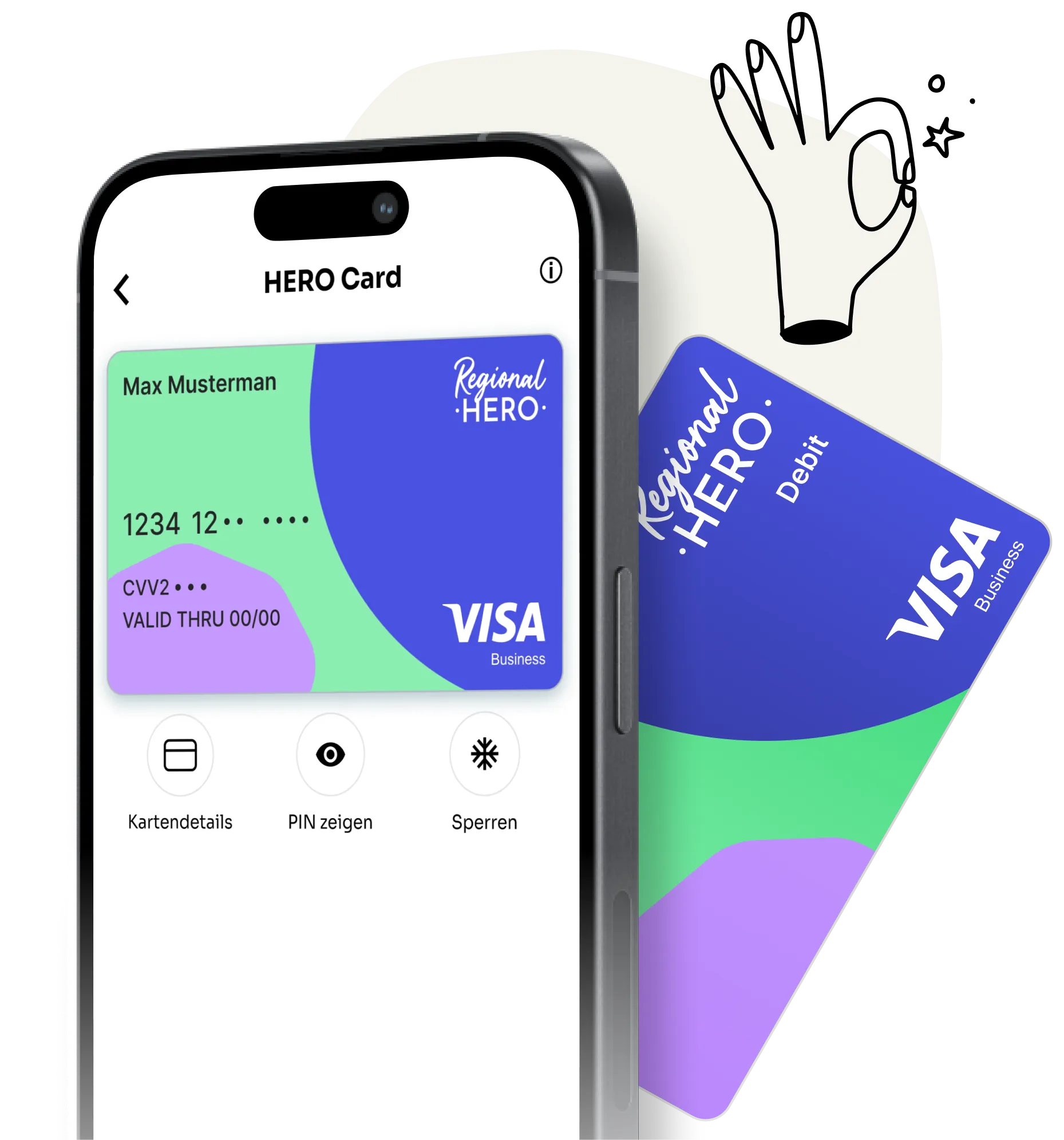
The HERO Card is a digital Mastercard debit card that allows companies to offer tax-free benefits easily and flexibly. Employees thus receive tax-free subsidies for benefits in kind, mobility, food and health. Everything bundled on one card, individually configurable and implemented in a legally secure manner.
Employees simply pay on a daily basis. Locally in your favorite café or nationwide in supermarkets, pharmacies or public transport.
How does that work for companies?
You control everything centrally in the HR portal.
Activate benefits in five minutes. The HERO Card automatically loads the monthly budget. Digital, secure and tax-compliant.
What are the concrete benefits of this for my team?
Up to 50 euros in kind per month
Meal allowance of up to 7.50 euros per working day
Mobility allowance of up to 58 euros per month
Up to 500 euros per year for health and wellbeing
All tax-free. It's all digital. It's all on one card.
How does HR keep track?
All benefits at a glance. No paperwork.
In the HR portal, you control budgets, see workload and manage everything centrally.
Sign in. Adjust. It's done.
This saves you up to 80 percent of administrative time.
Is that really tax-free?
Yes, all benefits are tax-free for employees and are completely legally compliant. Employers must tax some benefits as a lump sum.
The HERO Card uses legally enshrined allowances. Each category is correctly separated for tax purposes and can be managed automatically.
How much does the HERO Card cost?
As part of the employee license, the card costs 1 euro per employee per month plus charges for charging benefits.
For 50 employees with HERO Base, for example, this equates to around 140 euros per month — less than a joint team meal, but with a long-term effect.
How quickly is the HERO Card ready for use?
Ready to go in just a few days.
Setup, onboarding and go-live take a maximum of one week.
No technical hurdles. Without complexity.