Inhaltsverzeichnis


Implement a voucher system ▶️ Reward employees ✓ Optimize taxes ✓ Boost motivation ✓ Create added value!
STADTGUTSCHEINE – REGIONAL HERO
Mit den Stadtgutscheinen verschenkst du bis zu 250 Euro – einlösbar bei lokalen Händlern in der Region. Deine Mitarbeitenden freuen sich, die lokale Wirtschaft profitiert.
Infos zu StadtgutscheinenIn today's business world, companies are constantly seeking innovative strategies to motivate their employees while supporting local economic growth. One such strategy is the introduction of a regional voucher system. These systems offer tax-free employer benefits, promote value creation, foster employee loyalty, and simultaneously strengthen the relevance of local businesses. From rewarding employees to improving customer service, these systems offer a range of advantages. However, to fully leverage the potential diversity of voucher systems, a strategic approach is crucial. In this guide, we will explore the key aspects of voucher systems: from their fundamentals and associated tax benefits, through effective implementation strategies, to their impact on the local economy.
A voucher system is a strategic tool that enables companies to offer employees tax-optimized additional benefits. By utilizing non-cash benefit allowances, both employers and employees can save on social security contributions and taxes. This results in higher net compensation for the workforce and increases employer attractiveness and employee motivation.
In a corporate context, a voucher system is a method for providing employees with non-cash benefits that are tax and social security exempt up to a certain allowance limit. Instead of a direct salary increase, employees receive vouchers that they can redeem at selected partners such as supermarkets, gas stations, or online shops. This approach is based on legal regulations for non-cash benefits, which represent an alternative to traditional cash remuneration.
The system's operation is structured systematically. The company acquires voucher cards or digital voucher codes and distributes them to the workforce. Since these benefits are not considered direct wages but rather non-cash benefits, no wage tax or social security contributions are incurred, provided the current allowance limit of 50 Euros per month is observed. This mechanism makes the system financially attractive for both parties. Studies show that well-designed voucher systems can strengthen customer and employee loyalty, as they create a tangible added value that goes beyond mere salary [Neben].
Modern systems are often digitized and managed via a platform or app. Employees can view their balance there and choose from various acceptance partners. This trend towards the digitalization of vouchers was intensified by the pandemic and particularly meets the expectations of younger target groups [Ingenico Marketing Solutions]. The flexibility and freedom of choice offered by such systems are crucial for their acceptance and effectiveness within the company.
Vouchers as non-cash benefits offer significant tax advantages, as they are tax and social security exempt up to a monthly allowance limit of 50 Euros per employee . This means that the gross value of the voucher is received net by employees, which would not be the case with a regular salary increase. This effectively increases the purchasing power of employees.
For employers, this also results in financial relief. Since no employer contributions to social security are incurred on the value of the voucher, ancillary wage costs are reduced. "If-then" scenarios illustrate this: If a company grants 100 employees a monthly 50-Euro voucher, it saves several thousand Euros annually in social security contributions compared to a gross salary increase of the same amount. This saving can be reinvested or used to finance further benefits.
In addition to the monthly 50-Euro allowance limit, there is the option to grant tax-free non-cash benefits of up to 60 Euros . Such vouchers are considered tokens of appreciation and can further emphasize employee recognition. The use of these tax instruments allows for targeted control of consumption and can be used to meet specific needs of the workforce [Institut der deutschen Wirtschaft].
The successful implementation of a voucher system requires structured planning and clear communication. First, the legal and tax frameworks must be reviewed to ensure compliance, particularly with the provisions of § 8 Abs. 2 EStG. Based on this, a suitable system solution is selected that meets the needs of the company and its workforce.
A phased introduction has proven effective in practice:
Voucher systems can be distinguished by their flexibility, redemption method, and tax treatment. Choosing the right system depends on the company's goals and employee preferences. Generally, a distinction is made between open (Open-Loop) and closed (Closed-Loop) systems, as well as digital and physical systems, each with its own advantages and disadvantages.
A key distinguishing feature is the tax classification. Here, the benefit in kind is particularly relevant, which is tied to strict criteria. The following table compares common voucher types:
User choice is a crucial factor for success. Systems that offer a wider range of redemption options are generally better received [Fink]. However, tax compliance must always be ensured.
Vouchers increase employee motivation because they are perceived as a visible sign of appreciation that goes beyond regular salary. Since the net value of the voucher reaches the employee, the psychological effect is often greater than with a gross salary increase, from which less remains after taxes and social security contributions. This form of reward feels more direct and tangible.
Introducing a voucher system signals that the company actively cares for the well-being of its workforce. This strengthens emotional ties to the employer and can reduce turnover. Vouchers are also used to encourage participation in initiatives, which underscores their motivating effect [Institute for Employment Research]. According to a survey, 63 percent of Germans favor vouchers as gifts, indicating a high level of general acceptance [Brandt, Statista 2024].
Such benefits play an increasingly important role in making a company attractive in the competition for skilled workers. A modern, flexible voucher system is a tangible advantage that can be communicated during the recruitment process. It shows that the company is innovative and invests in its employees. Especially if the system offers a wide choice between various providers such as retail, gastronomy, or wellness, it is perceived as particularly attractive. Such systems can help the company stand out positively from the competition [Neben].
In Germany, the tax-free allowance for non-cash benefits is 50 Euros per month per employee. If this amount is exceeded by even one cent, the entire amount becomes subject to tax and social security contributions. Additionally, there is a tax-free allowance of 60 Euros for personal occasions such as birthdays.
Whether digital or physical vouchers are better depends on the target audience. Digital vouchers are more environmentally friendly, immediately available, and easy to manage. They are particularly preferred by younger, tech-savvy employees. Physical cards can be more accessible for employees without smartphones or with lower digital affinity.
If a voucher is not redeemed, its value expires after the validity period. This represents a disadvantage for the employee. A study showed that 40 percent of recipients let at least one voucher expire [YouGov]. Companies should therefore ensure long validity and simple redemption processes.
Yes, vouchers as tax-free non-cash benefits can be granted to all employees, regardless of their contract type. This includes part-time employees, mini-jobbers, and apprentices. The tax-free allowances apply per person and are not dependent on the scope of employment, making them a fair benefit for the entire workforce.
Everything you want to know — simply explained.
Everything you want to know — simply explained.
What is the benefit card?
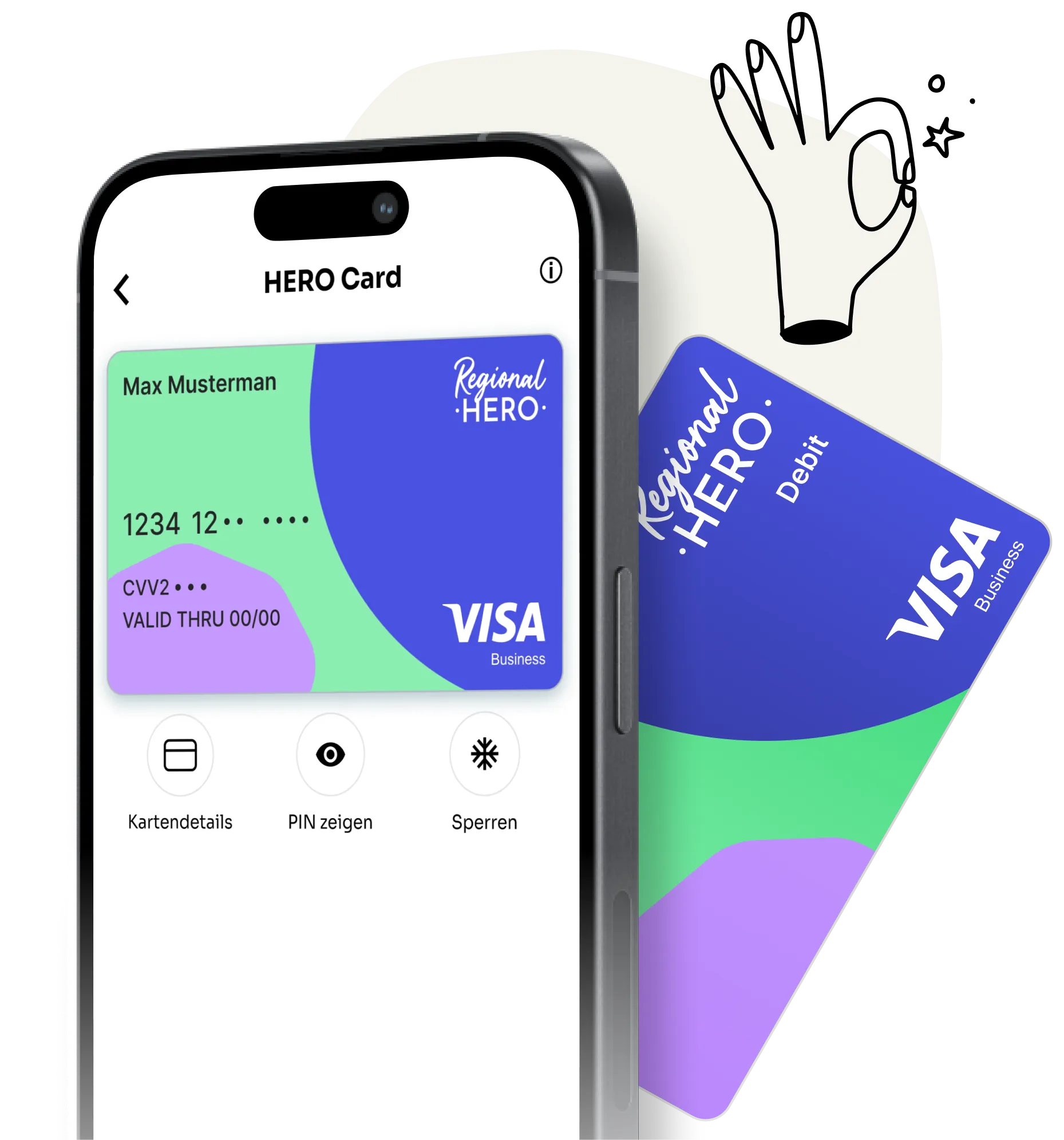
The HERO Card is a digital Mastercard debit card that allows companies to offer tax-free benefits easily and flexibly. Employees thus receive tax-free subsidies for benefits in kind, mobility, food and health. Everything bundled on one card, individually configurable and implemented in a legally secure manner.
Employees simply pay on a daily basis. Locally in your favorite café or nationwide in supermarkets, pharmacies or public transport.
How does that work for companies?
You control everything centrally in the HR portal.
Activate benefits in five minutes. The HERO Card automatically loads the monthly budget. Digital, secure and tax-compliant.
What are the concrete benefits of this for my team?
Up to 50 euros in kind per month
Meal allowance of up to 7.50 euros per working day
Mobility allowance of up to 58 euros per month
Up to 500 euros per year for health and wellbeing
All tax-free. It's all digital. It's all on one card.
How does HR keep track?
All benefits at a glance. No paperwork.
In the HR portal, you control budgets, see workload and manage everything centrally.
Sign in. Adjust. It's done.
This saves you up to 80 percent of administrative time.
Is that really tax-free?
Yes, all benefits are tax-free for employees and are completely legally compliant. Employers must tax some benefits as a lump sum.
The HERO Card uses legally enshrined allowances. Each category is correctly separated for tax purposes and can be managed automatically.
How much does the HERO Card cost?
As part of the employee license, the card costs 1 euro per employee per month plus charges for charging benefits.
For 50 employees with HERO Base, for example, this equates to around 140 euros per month — less than a joint team meal, but with a long-term effect.
How quickly is the HERO Card ready for use?
Ready to go in just a few days.
Setup, onboarding and go-live take a maximum of one week.
No technical hurdles. Without complexity.