Inhaltsverzeichnis


Launch a City App for Employees ▶️ Bundle local offers ✓ Boost employee engagement ✓ Enhance location appeal ✓ Connect now!
STADTGUTSCHEINE – REGIONAL HERO
Mit den Stadtgutscheinen verschenkst du bis zu 250 Euro – einlösbar bei lokalen Händlern in der Region. Deine Mitarbeitenden freuen sich, die lokale Wirtschaft profitiert.
Infos zu StadtgutscheinenIn today's world, digitalization plays an increasingly important role in all areas of life. This is also reflected in the growing use of city apps. They are long since more than just digital city maps – they offer a multitude of opportunities that can be highly beneficial for employers and employees alike, as well as for the local economy. Employees are more motivated and loyal when they feel valued by their company. And this is precisely where city apps can unleash their true potential. With them, you can not only give your employees easy and convenient access to local offers, but you can also use them as a tool for sustainable support of the regional economy. Below, you will learn more about the diverse applications – from employee retention and strengthening the regional economy to future prospects and development potential of this innovative technology.
A city app functions as a central digital interface that bundles local information, municipal services, and commercial offers. For companies, it represents an effective tool to strengthen employee loyalty, enhance the attractiveness of the location, and actively integrate into the urban ecosystem. By providing relevant, location-based content, not only is the daily life of the workforce made easier, but the local economy is also sustainably promoted. The strategic introduction of such an application can thus become a decisive competitive advantage in the competition for qualified professionals.
The technological foundation for such applications is created by the progressive digitalization of German cities. Platforms that aggregate data from various sources form the backbone for multifunctional city apps. [PwC] If a municipality has already invested in a digital infrastructure, companies can build upon it to create specific offers for their employees. This leads to a win-win situation: employees benefit from a value-added service, the company strengthens its employer branding, and the city increases its digital visibility and citizen-friendliness. The challenge often lies in establishing the necessary technical and social structures to operate such a platform sustainably. [Forschungsprojekt molo.news]
The effectiveness of a city app largely depends on the relevance and quality of the content provided. It's not just about displaying information, but about creating real, tangible added value. This can be achieved through exclusive partnerships with local businesses, the integration of real-time public transport schedules, or the display of daily lunch menus in the vicinity. As app usage in Germany is continuously increasing and in 2023 a total of 2.4 billion apps were downloaded, the potential for high acceptance among the workforce is enormous. [BVDW]
A city app in a corporate context is a mobile application specifically designed to connect a company's employees with their local environment. It bundles relevant information such as local news, events, gastronomic offers, mobility services, and exclusive employee benefits with local partners.
Unlike purely public city apps, which are aimed at all citizens, an in-house corporate city app offers curated content tailored to the needs of the workforce. It can function as part of a corporate benefits program or as an employer branding tool. Because the app can be designed as a closed ecosystem for the company and its partners, it enables the provision of exclusive benefits that would not be available in public apps. This exclusive character increases the perceived value for employees and promotes identification with the employer and the location.
Such applications are an integral part of a "Smart City Ecosystem" where digital technologies are used to improve quality of life and optimize urban processes. [Fraunhofer IESE] They act as a bridge between a city's digital strategy and the needs of the local economy and its employees. When a company provides such an app, it makes an active contribution to the digital transformation of the location and positions itself as an innovative and employee-oriented player in the region.
For employees, a city app primarily offers convenience, time savings, and financial benefits. By centralizing information on local offers, events, and transportation, the need to consult multiple websites or apps is eliminated, which significantly eases daily life and improves work-life balance.
Especially for new or relocated employees, a city app is a valuable tool for integration. It helps them quickly find their way around their new home and workplace, discover social connections, and feel welcome. This accelerates the onboarding process and can reduce the turnover rate during the critical initial phase. As the app provides direct access to local services and leisure activities, it fosters a sense of belonging and "arrival" at the new location.
Another significant advantage lies in potential cost savings. Through exclusive discounts and special offers with local partners – from restaurants and gyms to retail – employees receive a monetary benefit. The app thus becomes a visible and daily usable benefit. Analyses show that such digital solutions contribute to modernization and improve communication between various stakeholders, such as companies, employees, and local providers. [NEGZ]
The bundling of information also improves planning reliability and spontaneity. Whether it's about finding a free parking space, the next bus departure, or a cultural event in the evening – real-time data in the app enables informed and quick decisions. As AI and crowdsourcing data are increasingly integrated, service quality continuously improves, further optimizing the user experience. [Fraunhofer IESE]
A city app is a strong tool for employer branding, as it makes a company's commitment to the well-being of its employees visible beyond the workplace. It signals a modern corporate culture and positions the company as an attractive, caring, and locally rooted employer.
In the competition for skilled workers, such an offering can be a decisive differentiating factor. While salary and job content are often comparable, additional benefits like a city app can tip the scales. It shows that the company invests in the work-life balance and social integration of its workforce. When a company actively contributes to easing the daily lives of its employees and making the location more livable, this sustainably increases employer attractiveness. Impact analyses of Smart City projects show that such initiatives promote new forms of cooperation and modernize administration. [BBSR]
Furthermore, promoting local partners strengthens the company's roots in the region. By encouraging employees to use local businesses and service providers, the company contributes to strengthening the local economy. This commitment, in the spirit of Corporate Social Responsibility (CSR), can be positively communicated externally and improves the company's image with the public and municipal administration. The app thus becomes a symbol of a vibrant partnership between the company and the city.
The successful implementation of a city app requires a structured approach across several phases. It begins with defining strategic goals: it must be clear whether the focus is on employee retention, recruiting, local economic development, or a combination of these objectives.
Based on these goals, the conceptualization phase follows. A needs analysis among employees is crucial here to identify relevant content and functions. Concurrently, the technological platform should be selected. Municipalities and companies face the choice between developing their own application, using a white-label solution, or connecting to an existing urban platform. Open-source solutions like the "Mensch Solingen App" offer a flexible and cost-effective alternative. [acatech Praxisprojekt]
Operational implementation primarily involves content management and building partnerships. Relevant content must be continuously maintained, and collaborations with local businesses established. The rollout should be gradual, ideally with a pilot group, to gather feedback and optimize the app before its company-wide launch. An accompanying internal communication campaign is crucial to promote the app's acceptance and usage from the outset.
Phases of City App Implementation
The success of a city app is measured using clearly defined Key Performance Indicators (KPIs). These include quantitative metrics such as download and installation rates, the number of monthly active users (MAU), and time spent in the app. Qualitative indicators are equally important.
Specific interaction metrics provide insights into the popularity of individual features. These include click-through rates on specific offers, coupon redemptions, or participation in in-app surveys. Regular employee feedback, gathered through integrated rating tools or separate surveys, provides valuable qualitative insights into user satisfaction and potential for improvement. Data-driven strategies are essential for optimizing such platforms. [Deutscher Städtetag]
Support for the local economy becomes measurable when the app directly or indirectly records transactions. For example, the number of digital coupons redeemed at local partners can be tracked. This provides concrete proof of the additional revenue generated for local retail and gastronomy. Because the app functions as a direct channel to a target group with purchasing power, it becomes an attractive marketing tool for local businesses. This strengthens business relationships at the location and promotes a positive corporate image.
A company-specific city app offers curated, exclusive content for the workforce, such as internal news or special employee discounts. Public apps are aimed at all citizens and tourists, focusing on general information and municipal services, whereas the company app strengthens employee retention and employer branding.
The maintenance effort depends on the scope of features. Automated interfaces to news or event portals reduce manual effort. However, the acquisition and management of exclusive partner offers require human resources for continuous communication and updates to keep the app attractive.
Yes, especially in smaller locations, a city app can be particularly effective. It often consolidates sparsely available information, strengthens local cohesion, and makes the location more attractive for skilled workers. It can help positively influence the perception of a place and strengthen local identity.
Data protection is ensured through strict adherence to GDPR, a transparent privacy policy, and technical measures such as data encryption. App usage must be voluntary, and only data necessary for operation may be collected. Anonymized usage statistics help with optimization without personal reference.
Everything you want to know — simply explained.
Everything you want to know — simply explained.
What is the benefit card?
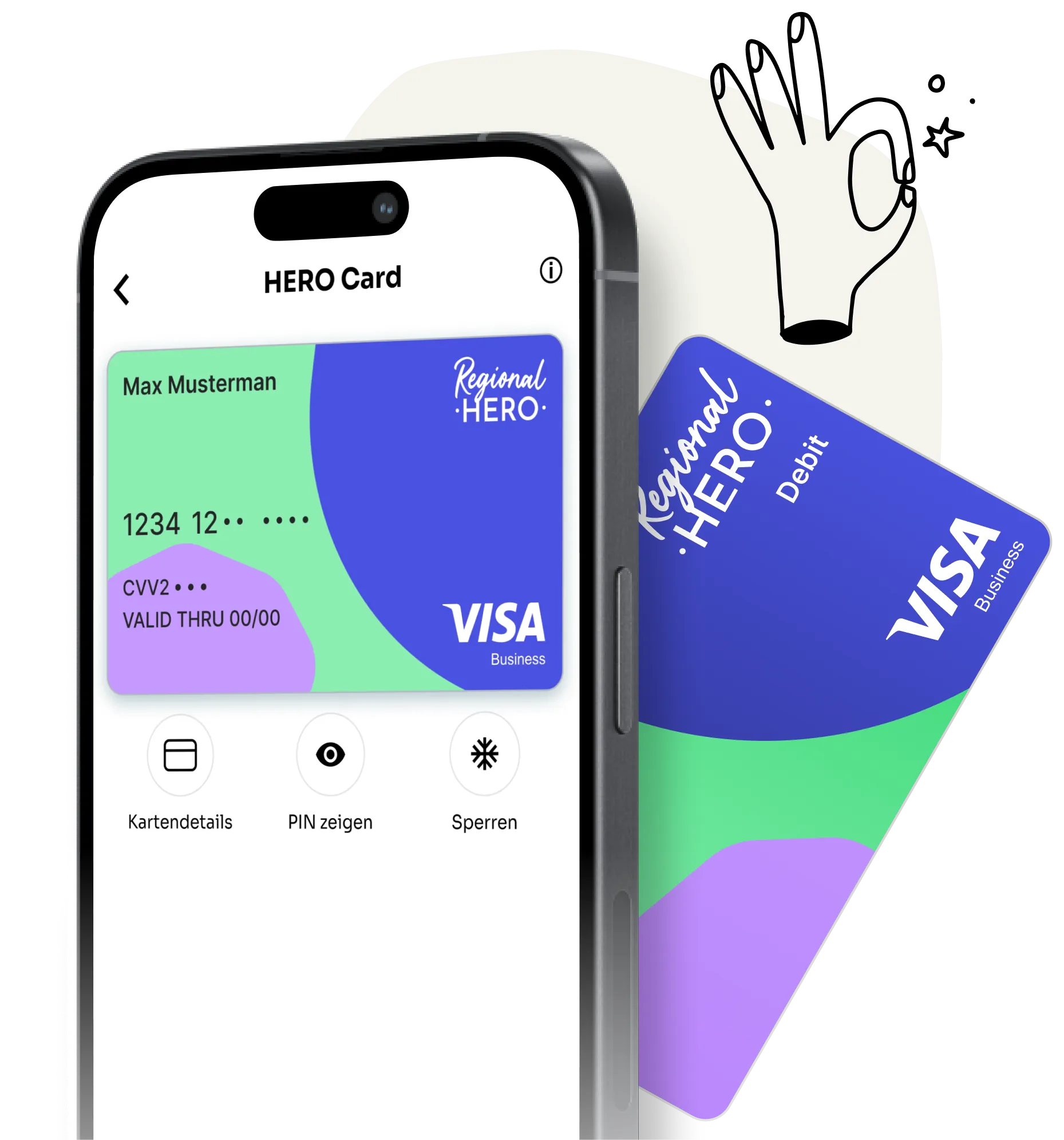
The HERO Card is a digital Mastercard debit card that allows companies to offer tax-free benefits easily and flexibly. Employees thus receive tax-free subsidies for benefits in kind, mobility, food and health. Everything bundled on one card, individually configurable and implemented in a legally secure manner.
Employees simply pay on a daily basis. Locally in your favorite café or nationwide in supermarkets, pharmacies or public transport.
How does that work for companies?
You control everything centrally in the HR portal.
Activate benefits in five minutes. The HERO Card automatically loads the monthly budget. Digital, secure and tax-compliant.
What are the concrete benefits of this for my team?
Up to 50 euros in kind per month
Meal allowance of up to 7.50 euros per working day
Mobility allowance of up to 58 euros per month
Up to 500 euros per year for health and wellbeing
All tax-free. It's all digital. It's all on one card.
How does HR keep track?
All benefits at a glance. No paperwork.
In the HR portal, you control budgets, see workload and manage everything centrally.
Sign in. Adjust. It's done.
This saves you up to 80 percent of administrative time.
Is that really tax-free?
Yes, all benefits are tax-free for employees and are completely legally compliant. Employers must tax some benefits as a lump sum.
The HERO Card uses legally enshrined allowances. Each category is correctly separated for tax purposes and can be managed automatically.
How much does the HERO Card cost?
As part of the employee license, the card costs 1 euro per employee per month plus charges for charging benefits.
For 50 employees with HERO Base, for example, this equates to around 140 euros per month — less than a joint team meal, but with a long-term effect.
How quickly is the HERO Card ready for use?
Ready to go in just a few days.
Setup, onboarding and go-live take a maximum of one week.
No technical hurdles. Without complexity.