Inhaltsverzeichnis


Leverage Economic Development for Employers: Unlock Location Advantages, Secure Funding, Build Networks, and Foster Growth!
STADTGUTSCHEINE – REGIONAL HERO
Mit den Stadtgutscheinen verschenkst du bis zu 250 Euro – einlösbar bei lokalen Händlern in der Region. Deine Mitarbeitenden freuen sich, die lokale Wirtschaft profitiert.
Infos zu StadtgutscheinenIn a globalized world, regional economies are more important than ever. A strong local economy forms the foundation for a region's prosperity and quality of life. Sustainable support for these ecosystems is therefore of immense importance. In particular, strategically utilized tax-free employer benefits play an indispensable role. They represent an efficient means of economic development and contribute to strengthening local markets. Employee retention is also positively influenced by investments in the regional economy. Regional non-cash benefit cards offer an innovative approach to simultaneously strengthen the local economy and employee retention. This unique combination of economic development and employee motivation changes the way companies perceive their social responsibility and shape their role in the regional economic landscape. Learn more about the various aspects of economic development and how you can implement them in your company.
Employers can strategically leverage economic development for their growth by specifically integrating the services offered into their business planning. This includes acquiring funding, utilizing consulting services for site development, building strategic networks, and unlocking advantages in skilled labor recruitment.
Municipal economic development agencies offer a wide range of services that go far beyond the mere allocation of commercial land. Their central goal is to improve the economic conditions at the location and actively support companies in their development. This includes consulting services, network facilitation, and support with approval processes.
A core area is existing business development, meaning the support and assistance for already established companies. Since these firms secure and create most jobs, strengthening them is a high priority. Economic development acts here as a central point of contact and a guide through the administration. For example, if a production expansion is planned, economic development helps clarify building law issues and facilitates contacts with the relevant authorities. This accelerates processes and significantly reduces the administrative effort for the company. The classic provision of commercial and industrial sites also remains a central task [Hollbach-Grömig, Beate].
Furthermore, the scope of tasks has expanded significantly. Modern economic development agencies are to be understood as complex network hubs that connect actors from business, science, and politics. They initiate cooperation projects, organize industry and technology meetings, and promote knowledge and technology transfer. For example, if a company plans an innovation in the circular economy, economic development can establish contact with local research institutions or specialized universities to provide scientific support for the project [Terstriep & Rabadjieva].
The effective acquisition of funding and grants requires a systematic approach and precise knowledge of the funding landscape. Companies should view economic development as a strategic partner that helps identify suitable programs from the EU, federal government, and states, and supports them with the application process.
The first step is a thorough needs analysis within your own company. What exactly are the funds needed for? Is it for investments in new machinery, financing a research and development project, digitalization measures, or opening up new markets? The clearer the project is defined, the more targeted the search for suitable funding programs can be. Many economic development agencies offer an initial consultation for this purpose, to structure the project and check its eligibility for funding. This initial consultation is usually free of charge for established companies.
Subsequently, research is conducted in funding databases. Economic development can provide valuable assistance here, as its staff often have a detailed overview of the relevant programs. Because many funding programs are thematically or industry-specific, expertise is crucial. An application for digitalization projects is subject to different criteria than a grant for energy-efficient production. Economic development helps to meet the formal requirements of the application, which are often complex and require specific wording. A study on the future of economic development shows that support in such processes plays an increasingly important role, especially after crises that have increased companies' financing needs [Lennardt und Birner].
Another important aspect is demonstrating the benefit for the region. If a company can show in its application that the investment contributes to the creation of new jobs, the strengthening of regional value chains, or an increase in the location's attractiveness, the chances of success increase. Since economic development has an inherent interest in the positive development of the location, it can help to present these arguments convincingly. Close cooperation thus significantly increases the likelihood of approval.
Location development is crucial for skilled labor recruitment because the attractiveness of a region is an essential factor in employees' decisions for or against a job. Soft location factors such as quality of life, cultural and leisure activities, or the availability of housing and childcare are just as important today as salary.
Companies no longer compete solely on job conditions, but also on the quality of the living environment they can offer their employees. If a location has excellent schools, good transport links, and a diverse cultural life, it becomes more attractive to highly qualified skilled workers and their families. Economic development plays an active role here by advocating for the improvement of these framework conditions. It works closely with urban planning, cultural offices, and other municipal actors to develop the location holistically. This approach is known as "location marketing" and explicitly targets potential employees as well.
Public acceptance of industry is also a relevant factor. A study by the Institute for Innovation and Technology shows that despite its high value creation, industry struggles with acceptance issues in some regions [Institut für Innovation und Technik (iit) Berlin]. If the local population has a positive attitude towards industry, this improves the social climate and makes it easier for companies to position themselves as attractive employers. Economic development agencies can build bridges here through targeted public relations, open days, or dialogue formats. They make companies' contributions to the region visible, thereby fostering a business-friendly climate that, in turn, attracts skilled workers.
For employers, this means: active participation in local economic development initiatives pays off. By engaging in location marketing campaigns or contributing to the development of concepts for a better work-life balance, companies not only strengthen the location but also their own employer brand. Economic development acts as a coordinator and multiplier, bundling the interests of companies and integrating them into municipal development.
Service Areas of Modern Economic Development and Their Benefits for Employers
Networks and collaborations play a central role in modern economic development, as they provide companies with access to valuable resources such as knowledge, technology, and new business partners. Economic development acts as an active network hub and moderator, initiating and supporting strategic alliances between various actors.
In today's knowledge-based economy, rapid access to innovation is a crucial competitive factor. Companies, especially small and medium-sized enterprises (SMEs), often lack the capacity to operate large-scale in-house research and development departments. This is where economic development agencies come in, facilitating collaborations with local universities and research institutions. A study by Harz University of Applied Sciences emphasizes the necessity of such collaborations to drive regional economic development [WiföLAB der Hochschule Harz]. For example, if a mechanical engineering company wants to digitalize its production, economic development can establish contact with an institute for automation technology. This can lead to joint projects supported by public funding.
Furthermore, economic development promotes the establishment of industry clusters and value chains in the region. By organizing themed business meetings, conferences, or joint exhibition stands, it brings together companies that can benefit from each other. This creates synergies: an IT company develops software for a local logistics provider, who in turn delivers the products of a manufacturing company. Such regional networks increase the resilience of the entire economic structure by reducing dependence on global supply chains and boosting local value creation. After the COVID-19 crisis, the importance of such resilient, local structures has significantly increased, as a survey among economic development professionals shows [Moduldrei].
Economic development has undergone a fundamental transformation due to recurring crises and advancing digitalization. Its role has evolved from mere existing business support and site marketing to a strategic crisis manager and transformation facilitator for the local economy.
Experiences from the financial and COVID-19 crises have shown that economic development agencies play a central role in stabilizing the local economy. They were often the first point of contact for businesses to obtain information on emergency aid and government support programs. This role as a crisis manager has become an integral part of their range of tasks [Springer Professional]. This also gives rise to a new focus on prevention and resilience. Instead of merely reacting, economic development agencies now proactively help businesses make their business models more resilient, for example, by diversifying supply chains or introducing flexible work models.
At the same time, digitalization is driving change. It is not only a key consulting area for businesses but also changes the way economic development agencies themselves operate. Digital participation formats, online consultations, and data-driven location analyses are becoming standard. A joint study involving the German Institute of Urban Affairs (Difu) highlights that the innovative capacity of economic development is crucial to support the socio-ecological transformation. This includes the promotion of sustainable business models, the circular economy, and social innovations [Wagner-Endres et al.]. The economic development of the future thus acts as a driver for sustainable and digitalized regional development, which also has positive effects on overall economic development, which, according to forecasts, will only grow moderately in the coming years [ifo Institut].
Typically, initial consultations and basic services from municipal or regional economic development agencies are free of charge for local businesses. They are funded by public money, as their work benefits the entire economic region. However, fees may apply for specialized, in-depth projects or workshops.
The right contact person is usually the economic development agency of your city, district, or federal state. Responsibility depends on your company's location. A simple online search for "economic development + [Name of your city/district]" usually leads directly to the responsible office.
The duration of a funding application process varies greatly depending on the program and its complexity. Simple grant programs can be approved within a few weeks. For large, investment-intensive projects, especially those with EU involvement, the process from application to approval can take several months or longer.
Yes, small and medium-sized enterprises (SMEs) are a key target group for economic development. Many funding programs and consulting services are explicitly tailored to the needs of SMEs, as they often do not have the same resources as large corporations for topics such as innovation, digitalization, or export.
Everything you want to know — simply explained.
Everything you want to know — simply explained.
What is the benefit card?
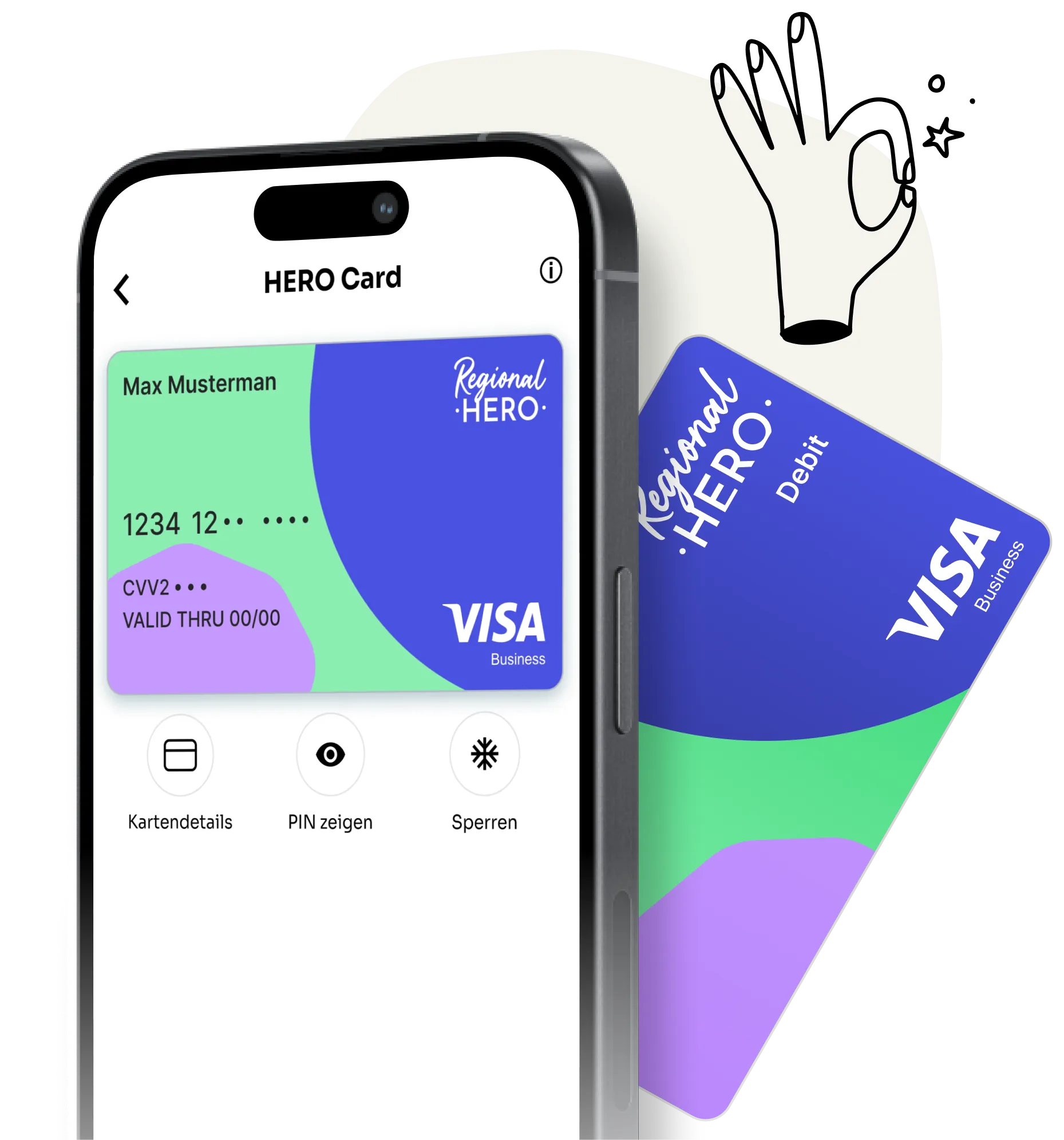
The HERO Card is a digital Mastercard debit card that allows companies to offer tax-free benefits easily and flexibly. Employees thus receive tax-free subsidies for benefits in kind, mobility, food and health. Everything bundled on one card, individually configurable and implemented in a legally secure manner.
Employees simply pay on a daily basis. Locally in your favorite café or nationwide in supermarkets, pharmacies or public transport.
How does that work for companies?
You control everything centrally in the HR portal.
Activate benefits in five minutes. The HERO Card automatically loads the monthly budget. Digital, secure and tax-compliant.
What are the concrete benefits of this for my team?
Up to 50 euros in kind per month
Meal allowance of up to 7.50 euros per working day
Mobility allowance of up to 58 euros per month
Up to 500 euros per year for health and wellbeing
All tax-free. It's all digital. It's all on one card.
How does HR keep track?
All benefits at a glance. No paperwork.
In the HR portal, you control budgets, see workload and manage everything centrally.
Sign in. Adjust. It's done.
This saves you up to 80 percent of administrative time.
Is that really tax-free?
Yes, all benefits are tax-free for employees and are completely legally compliant. Employers must tax some benefits as a lump sum.
The HERO Card uses legally enshrined allowances. Each category is correctly separated for tax purposes and can be managed automatically.
How much does the HERO Card cost?
As part of the employee license, the card costs 1 euro per employee per month plus charges for charging benefits.
For 50 employees with HERO Base, for example, this equates to around 140 euros per month — less than a joint team meal, but with a long-term effect.
How quickly is the HERO Card ready for use?
Ready to go in just a few days.
Setup, onboarding and go-live take a maximum of one week.
No technical hurdles. Without complexity.