Table of contents


Implement Net Pay Optimization ▶️ Increase employee satisfaction ✓ Save on taxes ✓ Boost employer appeal ✓ Optimize salaries now!
MultiBenefits - HERO CARD
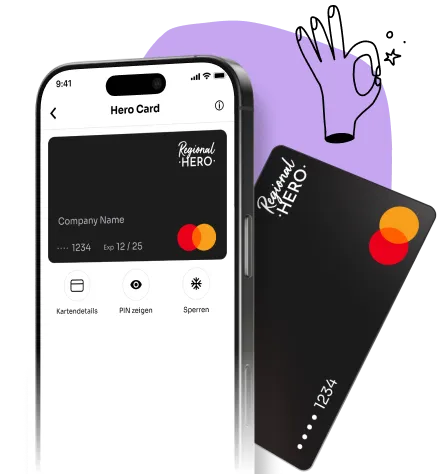
With the HERO Card, individual measures become a strong package, tax-free, digital and can be used anywhere.
HR keeps track of things, employees benefit directly.
You know the feeling: After a successful year and a good conversation with your boss, a salary increase is on the horizon. The joy is immense – until the first payslip arrives. Of the promised 200 Euros more per month, often barely half remains after taxes and social security contributions. Disappointing, isn't it? What if there was a way to increase your salary where 100% of the amount directly reaches you?
That's exactly what net pay optimization is.
Net pay optimization means increasing your net salary through tax- and social security-free additional benefits instead of a classic gross salary increase. This way, salary extras like non-cash benefits, allowances, or vouchers reach you 1:1, without any deductions.
This isn't about tax tricks, but about the clever and completely legal use of government-supported additional benefits, also known as corporate benefits. The legislator created these opportunities to provide employees with more disposable income and to offer employers a cost-efficient alternative to traditional salary increases.
In this ultimate guide for 2025, we'll show you everything you need to know about net pay optimization. We'll dive deep into the world of tax-free salary extras, explain the most powerful tools, and provide you with a practical guide on how you – whether as an employee or an employer – can leverage these benefits.
Net pay optimization is far more than just a clever way to save money. It's a modern form of compensation that brings enormous advantages for both sides – employees and employers. It's a real game-changer for the working world.
The core problem with a traditional salary increase is the so-called Gross-to-Net Trap. The progressive nature of the German tax system and social security contributions mean that a significant portion of every additional Euro earned is directly paid back to the state. A gross salary increase of 200 Euros per month for an average salary (tax class I, approx. 47,000 Euros annual salary) often results in a net increase of only around 96 Euros. The disappointment this causes is a strong motivation to look for better alternatives.
This is where tax-free benefits unleash their superpower. A tax-free non-cash benefit worth 50 Euros means that 50 Euros gross is also 50 Euros net. The full amount reaches you 1:1, without any deductions. You immediately have more purchasing power in your pocket that you can use for your daily life.
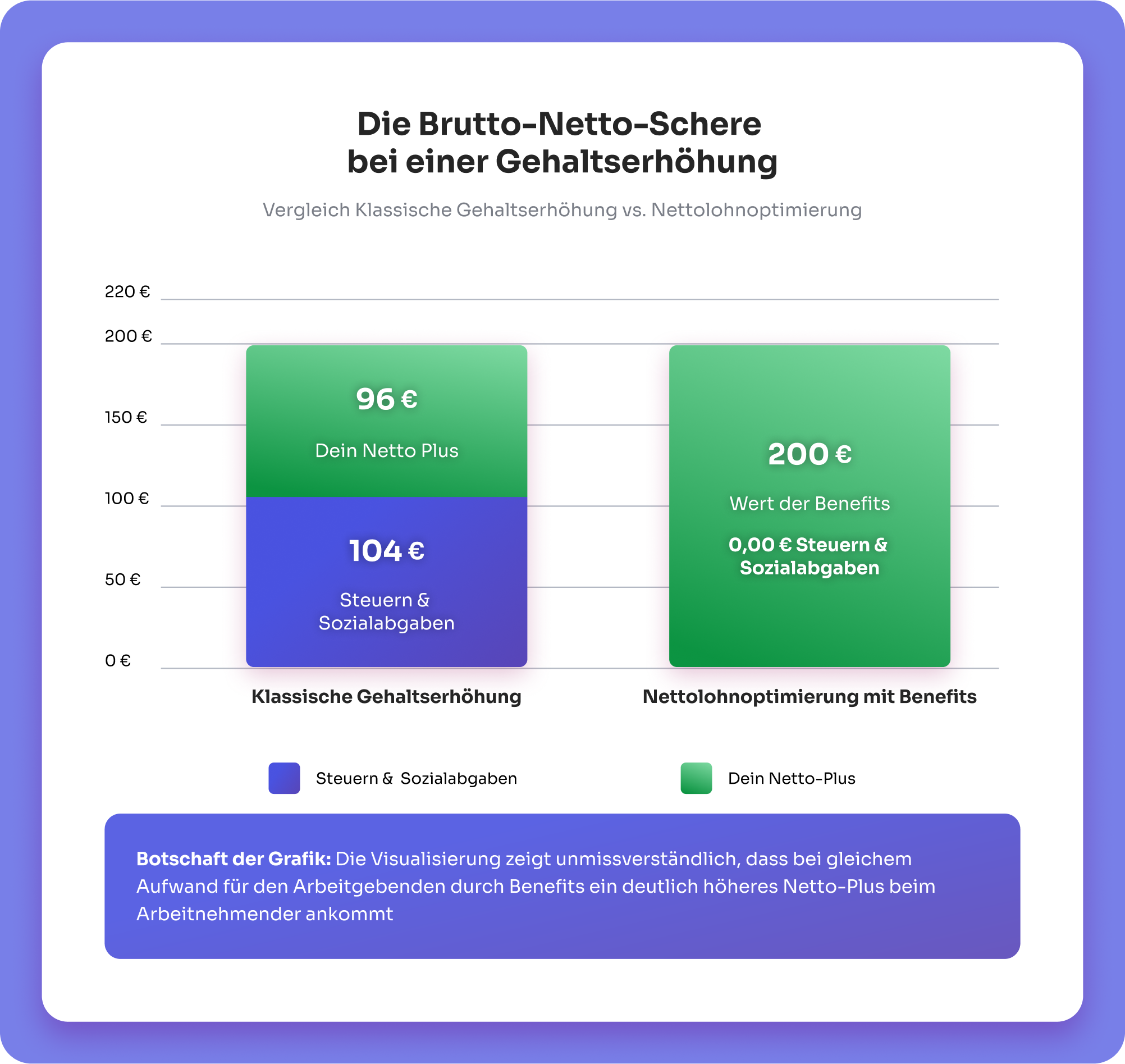
For companies, net pay optimization is a strategic tool that goes far beyond mere cost savings.
Employer Branding & Recruiting: In a competitive job market, attractive and modern employee benefits often tip the scales. They signal an appreciative and progressive company culture and make you, as an employer, significantly more attractive to top talent.
Savings on Non-Wage Labor Costs: The financial advantage is enormous. For every gross salary increase of 100 Euros, an employer additionally pays around 20-23 Euros in social security contributions. With tax-free non-cash benefits, these non-wage labor costs are completely eliminated. The money saved can be directly invested in further employee benefits or company growth.
Employee motivation and retention: A monthly allowance that makes a noticeable difference to employees' wallets is a tangible form of appreciation. Such benefits often boost satisfaction, morale, and loyalty to the company more sustainably than a small net increase that gets lost in the monthly salary. It's particularly effective when these benefits tell a story – for example, supporting local businesses, which transforms a purely financial decision into a value-driven action.
The legislature offers a comprehensive toolkit of options. We'll open it up for you and take a close look at the most important and effective instruments for 2025.
The 50-euro non-cash benefit is the most flexible and popular instrument for net pay optimization. It's a true all-rounder.
Your employer can provide you with goods and services worth up to 50 euros per month, tax-free and exempt from social security contributions. This must be in addition to your regular salary and cannot be paid out in cash.
The basis for this benefit is § 8 Abs. 2 Satz 11 des Einkommensteuergesetzes (EStG). A crucial detail you need to know: The 50 euros is an exemption limit, not an allowance. This means: If this value is exceeded by even a single cent (e.g., 50.01 euros), the entire amount becomes subject to tax and social security contributions. Precision is therefore everything here.
For the €50 non-cash benefit to truly remain tax-free, three key conditions must be met:
1. "In addition to the salary already owed": This is the so-called "additionality principle". The benefit must not be offset against the existing salary. A salary conversion, where a portion of the gross salary is converted into a non-cash benefit, has been legally excluded since 2020 and is therefore illegal.
2. No cash payout: The benefit must be granted as a non-cash service. Vouchers or cards must not have a cash-out function. Even a cash refund when exchanging goods is not permitted.
3. The ZAG criteria (since 2022): This is where many older voucher systems fail. To qualify as a non-cash benefit, vouchers and money cards must meet the strict criteria of the Payment Services Supervision Act (Section 2, Paragraph 1, No. 10 ZAG) . These rules were introduced to prevent non-cash benefits from being used like cash. Simply put, the card's usability must be restricted. The three most important criteria are:
The strict ZAG criteria mean the end for many universally usable prepaid credit cards as tax-free non-cash benefits. However, they have paved the way for smarter and better solutions.
The smartest implementation today are digital prepaid cards specifically developed for these rules. Imagine a card you can use like a normal debit card (e.g., Mastercard), but with a clever regional focus. You can use it to pay at the bakery around the corner, your favorite bookstore, or the supermarket in your neighborhood. The money stays in your region and strengthens local businesses – a double win for you and your community. These cards offer maximum flexibility for you as a user and, at the same time, full legal certainty for your employer.
Typical examples of how the €50 non-cash benefit can be used include fuel vouchers, supermarket purchases, gym memberships, streaming services, or buying books.
No canteen at the office? No problem! With a meal allowance, your employer can financially subsidize your daily lunch break – and with significant tax benefits.
In 2025, your employer can subsidize your lunch or dinner with up to 7.50 Euros per working day. This amount consists of the flat-rate taxed non-cash benefit (4.40 €) and a tax-free allowance (3.10 €).
The maximum allowance of 7.50 Euros per day is a voluntary benefit from the employer. For 2025, it is structured as follows:
Assuming 15 working days per month, this results in a tax-advantaged bonus of up to 112.50 Euros, which you receive directly.
Forget cumbersome paper meal vouchers that are only accepted in specific restaurants. Modern systems work simply and digitally via an app. The process is incredibly straightforward: You eat lunch wherever you want – at a restaurant, a snack bar, or you grab a salad at the supermarket. Afterwards, you photograph the receipt with your smartphone, upload it to the app, and the allowance is automatically reimbursed with your next salary. This means maximum flexibility for you and minimal administrative effort for the HR department.
A few important rules to note: The allowance may only be granted for actual working days (i.e., not during vacation or sick days). To reduce administrative effort, the so-called 15-day rule established, where a flat rate of 15 days per month are subsidized without requiring proof of individual days of absence. Receipts must be kept as proof.
In addition to the monthly non-cash benefit, there's another delightful way to treat employees: tokens of appreciation for special personal occasions.
For this, a tax-free limit of 60 Euros (gross) per occasion applies, as regulated in the Income Tax Guidelines (R 19.6 LStR). It's important that there must be a specific, personal reason.
Valid personal occasions include, for example:
The best part: These 60 Euros are completely independent of the 50-Euro non-cash benefit. So, in your birthday month, you can receive both your regular 50-Euro non-cash benefit and a gift worth up to 60 Euros tax-free. This is a wonderful gesture of appreciation that comes without deductions.
Employee health is a valuable asset. That's why the state supports workplace health initiatives with a generous tax bonus.
Your employer can support your health with up to 600 Euros per year tax-free. This applies to certified courses in areas such as stress management, nutrition, exercise, and addiction prevention, in addition to your normal salary.
The basis is § 3 No. 34 EStG, which provides an annual tax-free allowance of 600 Euros per employee. Unlike the 50-Euro tax-free limit, this is a tax-free allowance. This means that if the 600 Euro amount is exceeded, only the excess portion is subject to tax, not the entire sum.
The tax exemption is tied to clear conditions. It covers quality-assured prevention and health promotion measures that meet the criteria of § 20 SGB V.
What is covered?
What is NOT covered?
The future of corporate health promotion lies in integrated systems. Imagine being able to conveniently manage various budgets – for your health, your mobility, or your daily shopping – all through a single app and a single card. This creates maximum transparency and makes using benefits easier and more straightforward than ever before.
The toolkit for net wage optimization has even more to offer. The following table provides a quick overview of other popular salary extras for 2025.
Theory is good, but how does it look in practice? Let's run the numbers with a concrete example and show you how you can leverage these benefits for yourself.
Anna is an employee who negotiated a gross salary increase of 250 Euros per month. Her employer is smart and suggests a benefits package instead. Let's look at the difference:
Gross Increase: + €250
Deductions (Taxes & Social Security): approx. - €125
Anna's Net Increase: approx. €125
€50 tax-free non-cash benefit (net)
€112.50 meal allowance (for 15 working days, net)
€50 internet allowance (net)
Anna's Net Increase: €212.50
The result is clear: By optimizing her net pay, Anna has almost €90 more take-home pay per month in her pocket than with the classic salary increase. At the same time, her employer saves on ancillary wage costs for the 250 Euros. A clear win-win situation.

Do you, as an employer, want to leverage the advantages of net pay optimization? Perfect! With the right strategy, it's easier than you think.
Account correctly: Ensure that the granted benefits are correctly documented, separate from cash wages, on payslips and in payroll accounts. This is crucial for legal certainty during a tax audit.
Your employer doesn't offer benefits yet? Then take action yourself! Prepare well and present the idea as a constructive, business-oriented proposal.
Your arguments should focus on the win-win situation:
Cost savings: "I have an idea how the company can save on ancillary wage costs and simultaneously boost my motivation. Instead of a gross salary increase, we could use tax-free non-cash benefits."
Employee retention: "Modern benefits are a strong sign of appreciation and a significant advantage in the competition for skilled workers."
Low effort: "Today, there are digital providers who automate the entire process. The administrative effort for the HR department is minimal."
Frame it as an opportunity for the company to position itself as a modern and attractive employer, while even saving money.
Here we answer the most common questions about net salary optimization – concisely, precisely, and to the point.
Yes, absolutely. It involves utilizing legally established options within the Income Tax Act. Strict adherence to the rules is crucial, especially the 'Zusätzlichkeitsgebot' (principle of additionality – no salary conversion).
That's a crucial point! With an exemption limit (e.g., the 50 euros for non-cash benefits), the entire amount becomes taxable as soon as the limit is exceeded by even one cent. With an allowance (e.g., the 600 euros for health promotion), only the amount exceeding the allowance becomes taxable.
Yes! The principle of equal treatment also applies here. All employees are entitled to these benefits. Especially for mini-jobbers, benefits are an excellent way to enhance their income without exceeding the earnings limit and becoming subject to social security contributions.
Yes and no. The tax-free inflow of 50 euros must occur monthly and cannot be exceeded. Accumulating it over several months for a single payout is not permitted. BUT: The credit loaded monthly onto a non-cash benefit card can be saved by the employee to make a larger purchase later.
No problem. You can simply pay the remaining amount privately. The only important thing is that the value of the benefit provided by the employer does not exceed the 50-euro limit per month.
No. Tax-free benefits (such as the 50-euro non-cash benefit) or benefits taxed at a flat rate by the employer (such as the internet allowance) do not need to be declared by the employee in their personal income tax return.
Net salary optimization is the smartest way to increase your income in 2025. It's the answer to the frustration caused by the gross-net wage gap and a modern form of compensation that combines financial benefits with genuine, tangible appreciation. For employees, it means more purchasing power; for employers, it's an unbeatable tool for employee retention and cost savings.
Stop losing your hard-earned money to taxes and deductions. Take advantage of the clever opportunities the legislator offers you. And if you also support the cafes, shops, and restaurants in your neighborhood, your salary increase becomes a win for the entire region. Be a hero – for your wallet and for your city.
For Employees: Talk to your boss about these options. Show them this guide and start the conversation!
For Employers: Discover modern, digital benefit solutions that will delight your team and reduce your administrative burden. It's easier than you think!
author
Everything you want to know — simply explained.
Everything you want to know — simply explained.
What is the benefit card?
The HERO Card is a digital Mastercard debit card that allows companies to offer tax-free benefits easily and flexibly. Employees thus receive tax-free subsidies for benefits in kind, mobility, food and health. Everything bundled on one card, individually configurable and implemented in a legally secure manner.
Employees simply pay on a daily basis. Locally in your favorite café or nationwide in supermarkets, pharmacies or public transport.
How does that work for companies?
You control everything centrally in the HR portal.
Activate benefits in five minutes. The HERO Card automatically loads the monthly budget. Digital, secure and tax-compliant.
What are the concrete benefits of this for my team?
Up to 50 euros in kind per month
Meal allowance of up to 7.50 euros per working day
Mobility allowance of up to 58 euros per month
Up to 500 euros per year for health and wellbeing
All tax-free. It's all digital. It's all on one card.
How does HR keep track?
All benefits at a glance. No paperwork.
In the HR portal, you control budgets, see workload and manage everything centrally.
Sign in. Adjust. It's done.
This saves you up to 80 percent of administrative time.
Is that really tax-free?
Yes, all benefits are tax-free for employees and are completely legally compliant. Employers must tax some benefits as a lump sum.
The HERO Card uses legally enshrined allowances. Each category is correctly separated for tax purposes and can be managed automatically.
How much does the HERO Card cost?
As part of the employee license, the card costs 1 euro per employee per month plus charges for charging benefits.
For 50 employees with HERO Base, for example, this equates to around 140 euros per month — less than a joint team meal, but with a long-term effect.
How quickly is the HERO Card ready for use?
Ready to go in just a few days.
Setup, onboarding and go-live take a maximum of one week.
No technical hurdles. Without complexity.