Table of contents


Your ultimate guide to maximum tax benefits and flexible employee mobility. Find out everything about the mobility budget now!
Save with HERO RIDE

Flexible mobility budget instead of company cars. Up to 50€ per month tax-free for public transport, car sharing and more. Offer real freedom of choice, save costs and points as a modern employer.
Save costs nowThe weekly traffic jam on the way to the office? For many, it's just a vague reminder. The world of work has changed — more flexible, more digital, more individual. But has your employee mobility also adapted? While traditional benefits such as a rigid company car or a fixed job ticket are losing their luster in the age of home office and hybrid models, companies are looking for intelligent solutions that really fit the lives of their teams. They need tools that not only increase satisfaction, but are also cost-effective and support increasingly important sustainability goals.
This is where the mobility budget comes into play. It is much more than just another employee benefit; it is the strategic answer to tomorrow's mobility requirements. It offers freedom, fairness and promotes environmentally conscious transportation. And the best part: 2025 brings significant legislative changes that make the mobility budget more attractive and simple than ever before. This guide is your comprehensive compass through all aspects of the 2025 mobility budget. We'll show you how to make optimal use of it, avoid tax pitfalls and position your company as a modern, sustainable employer.
In this section, we dive deep into the basics. You will find out what the term means, the incredible variety of opportunities it opens up for you and why it is becoming a decisive factor for modern companies right now, in 2025.
A mobility budget is a fixed monthly amount that your employer makes available to you on a tax-deductible basis. You can use this credit flexibly for a variety of means of transport, such as public transport, car sharing, e-scooters or bicycles, according to your individual needs. It's like your personal mobility account for commuting to work and for private trips.
The true strength of a mobility budget lies in its flexibility. Instead of choosing a single mode of transport, it opens the door to an entire ecosystem of mobility options. The exact selection is determined by your company, but the offer typically includes:
This diversity enables multimodal mobility. You can therefore intelligently combine different means of transport: to the city by train, on by rental bike and back by taxi when it rains. This is not only practical, but also reflects the reality of modern life, in which no day is the same. The budget respects your autonomy and adapts to your needs — not the other way around.
The mobility budget is not a short-term fad, but the logical consequence of profound social and economic changes. In 2025, several megatrends will converge, turning the mobility budget from a “nice-to-have” into a strategic necessity:
The new, simplified tax laws from 2025 are the decisive catalyst. They remove the bureaucratic hurdles that have prevented many companies from implementing them so far. The simultaneous orientation of employee wishes, corporate goals and government funding creates a perfect environment for redesigning corporate mobility now.
This section is at the heart of our guide. Tax treatment has so far been the biggest hurdle when introducing a mobility budget. But 2025 brings clarity and new, attractive opportunities. We'll guide you step by step through the most important rules so that you can use all benefits legally and securely.
First things first: There isn't That one Mobility Budget Act. His tax treatment is a clever combination of various sections of the Income Tax Act (EStG). The decisive factor that decides on “tax-free” or “taxable” is the type of grant:
In the following, we will focus on the salary extra path, as it offers by far the biggest benefits for you and your company.
The tax-free payment in kind is the basis for many attractive employee benefits and is perfect for a small but fine mobility budget.
The 50-euro benefit in kind is a monthly amount that your employer can grant you completely tax-free and social security free of charge for goods or services. It is important that it is paid out as an extra salary and not in cash, for example via a prepaid card.
The legal basis is Section 8 (2) sentence 11 EStG. The following points are decisive:
A modern solution using a rechargeable card, which is limited to mobility service providers, ensures compliance with these rules and minimizes administrative costs.
This is the big innovation and the “game changer” for 2025: The legislator has recognized that €50 is often not enough and has created an attractive regulation for higher budgets.
What is the 25% flat tax?
From 2025, employers can subsidize mobility budgets of up to €2,400 per year (€200 per month) with a flat tax rate of just 25%. This amount is completely tax-free for employees and free of social security contributions for both sides if it is granted as a salary extra.
This new regulation in accordance with Section 40 Paragraph 2 No. 8 EStG-e is a revolution. It creates a simple and financially highly efficient way to offer all employees a truly substantial budget. Until now, amounts over €50 had to either be fully taxed individually or settled using the more complicated 30% lump sum tax. The new 25% rule is a clear political signal: Away from the old company car privilege, towards flexible and sustainable mobility for all. It democratizes the benefit and makes it easy to implement even for small and medium-sized enterprises.
Public transport is particularly promoted by the state. According to Section 3 No. 15 EStG, employer subsidies for trips by public transport in local transport (including Deutschlandticket) are completely free of tax and social security contributions. The amount is unlimited.
But the real superpower lies in the combinability: Your employer can give you the tax-free job ticket ancillary for a tax-free 50-euro payment in kind.
instance: You will receive the Deutschlandticket (assumed price 58€) completely tax-free. In addition, you get 50€ tax-free credit for car sharing, e-scooters or taxis. This results in a tax-free benefit of 108€ per month in total!
It is essential to understand this difference. If you waive part of your gross salary (salary conversion) in exchange for a mobility budget, the above tax exemptions generally do not apply. The amount is then treated as if it were a normal salary — i.e. fully subject to tax and social security contributions. This is a common and expensive mistake that negates the entire advantage. Real benefits, which are intended as an appreciation, should always be granted as a salary extra.
Table: Tax treatment of the mobility budget
A well-thought-out mobility budget is more than just a nice gesture. It is a powerful instrument that creates positive effects on several levels — for employees, for the company and even for society. Let's look at the benefits in detail.
For you as an employee, the mobility budget means one thing in particular: more freedom and more money in your pocket.
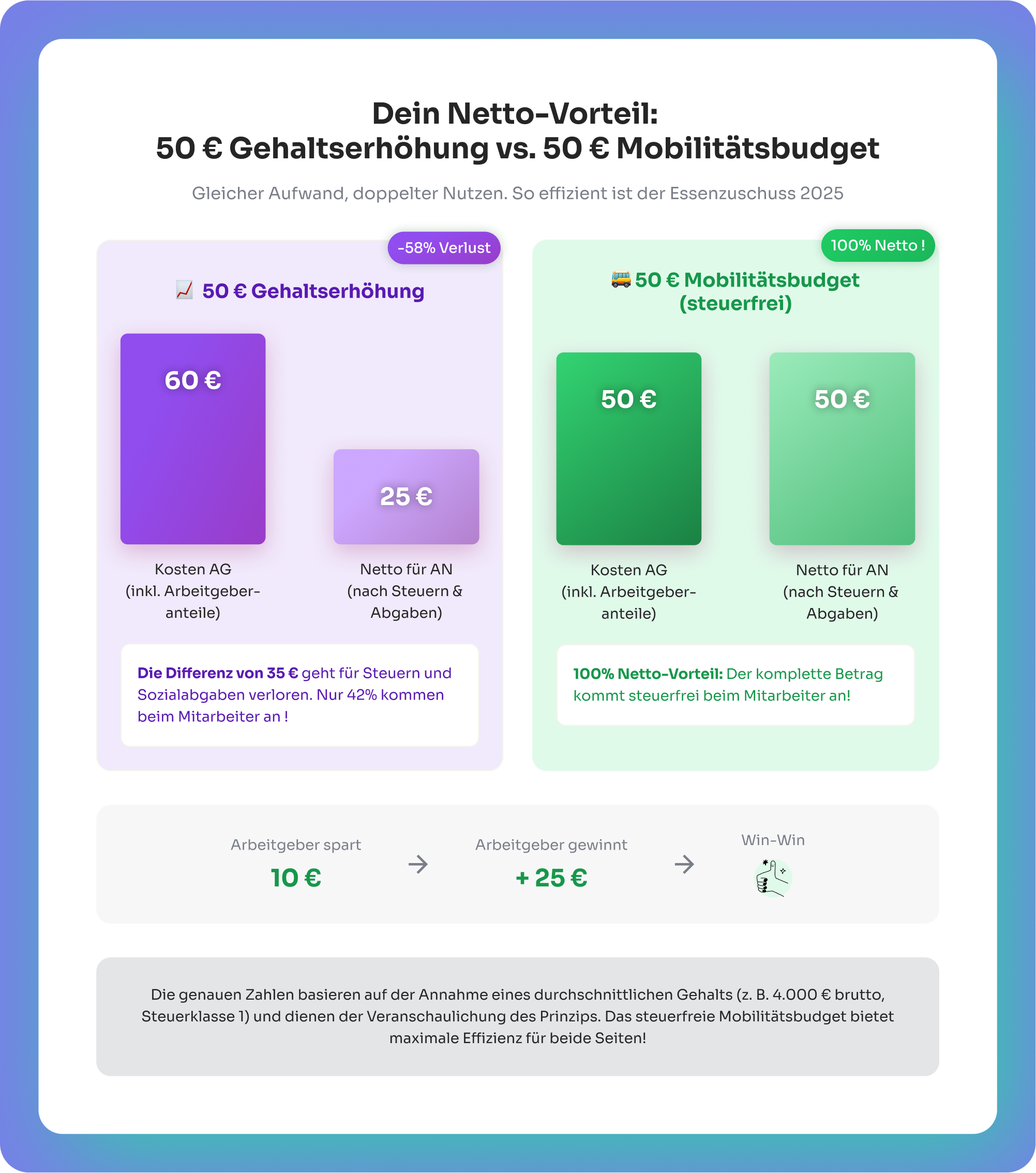
For your company, the introduction of a mobility budget is an investment that pays off several times over.
TechSolutions GmbH from Nuremberg, an up-and-coming company with 250 employees, faced a typical challenge: A high turnover of young IT specialists and an expensive, barely used fleet of vehicles that no longer fit the hybrid work culture. The HR department found that the benefits offered were perceived as “inflexible and off the shelf.”
Die Lösung: Das Unternehmen entschied sich für einen mutigen Schritt. Der bestehende Fuhrpark wurde verkleinert und stattdessen ein flexibles Mobilitätsbudget von 150 € pro Mitarbeiter und Monat eingeführt. Die Verwaltung erfolgte über eine digitale Plattform, die mit einer regional gebundenen Bezahlkarte verknüpft war. So wurde sichergestellt, dass das Geld nicht nur die Mitarbeiter mobil macht, sondern auch die lokale Wirtschaft in Nürnberg unterstützt.
Die Ergebnisse nach einem Jahr waren beeindruckend:
Diese Fallstudie zeigt: Ein Mobilitätsbudget ist keine reine Ausgabe, sondern eine Investition in das wichtigste Kapital eines Unternehmens – seine Mitarbeiter.
Der Firmenwagen war lange Zeit das unangefochtene Statussymbol und der begehrteste Benefit. Doch die Zeiten ändern sich. Insbesondere in Städten und bei einer jüngeren Belegschaft wird das eigene Auto oft mehr zur Belastung als zur Belohnung.1 Stau, Parkplatznot und hohe Kosten lassen den Traum vom Dienstwagen verblassen. Hier positioniert sich das Mobilitätsbudget als die smarte, flexible und oft auch günstigere Alternative.
Es gibt keine pauschale Antwort, aber klare Tendenzen. Das Mobilitätsbudget spielt seine Stärken vor allem in folgenden Szenarien aus:
Ein klassischer Dienstwagen bleibt hingegen in bestimmten Fällen die sinnvollere Lösung:
Die intelligenteste Lösung ist oft nicht ein "Entweder-Oder", sondern ein flexibles System, das beiden Realitäten gerecht wird.
Um eine fundierte Entscheidung zu treffen, müssen alle Kosten auf den Tisch. Ein Dienstwagen verursacht weit mehr als nur die monatliche Leasingrate. Hinzu kommen Versicherung, Steuern, Wartung, Reifen, Kraftstoff und ein erheblicher interner Verwaltungsaufwand. Das Mobilitätsbudget hingegen ist ein klar definierter, planbarer Kostenblock.
Der Übergang von einer traditionellen Dienstwagenregelung zu einem flexiblen Mobilitätskonzept muss nicht über Nacht geschehen. In der Praxis haben sich drei strategische Modelle bewährt, die einen sanften oder auch radikalen Wandel ermöglichen.
Die Entscheidung ist gefallen, aber wie geht es jetzt weiter? Eine erfolgreiche Implementierung steht und fällt mit einer guten Planung und der Wahl der richtigen Werkzeuge. Die gute Nachricht: Mit einer digitalen Lösung ist der Prozess einfacher als du denkst.
Ein strukturierter Ansatz ist der Schlüssel zum Erfolg. Folge diesen vier Schritten, um dein Mobilitätsbudget auf eine solide Basis zu stellen:
Der administrative Aufwand ist die größte Sorge vieler Unternehmen bei der Einführung neuer Benefits. Ein Mobilitätsbudget kann steuerlich komplex sein. Die Lösung liegt in einer intelligenten Software-Plattform, die dir die Arbeit abnimmt. Eine ideale digitale Lösung sollte folgende Merkmale aufweisen:
Die Wahl der richtigen Plattform verwandelt eine potenziell komplexe Verwaltungsaufgabe in einen schlanken und effizienten Prozess.
Hier kommt ein strategischer Kniff ins Spiel, der dein Mobilitätsbudget von einem reinen Benefit zu einem Statement für unternehmerische Verantwortung macht. Anstatt eine globale Plattform zu nutzen, die das Geld an internationale Konzerne weiterleitet, kannst du eine Lösung wählen, die das Budget gezielt in deiner Region hält.
Stelle dir vor, das Mobilitätsbudget deines Teams tankt nicht nur den E-Roller, sondern belebt auch den lokalen Fahrradladen um die Ecke, unterstützt die städtischen Verkehrsbetriebe und sorgt dafür, dass das Café am Bahnhof floriert. Technisch wird dies durch Bezahlkarten realisiert, die auf ein bestimmtes Postleitzahlengebiet beschränkt sind. Dies ist nicht nur eine Einschränkung, sondern eine bewusste Entscheidung für Corporate Social Responsibility. Du zeigst damit, dass dein Unternehmen in der Region verwurzelt ist und einen aktiven Beitrag zur Stärkung der lokalen Wirtschaft leistet. Das ist mehr als ein Benefit – das ist ein Bekenntnis zu eurer Heimat.
Diese Frage sollte in deiner Richtlinie klar geregelt sein. Es gibt verschiedene Modelle, die jeweils ihre eigenen Vor- und Nachteile haben.
Die Pandemie hat die Arbeitswelt nachhaltig verändert. Das Homeoffice ist für viele zur neuen Normalität geworden, und hybride Modelle sind der Standard. Diese neue Realität erfordert ein radikales Umdenken bei der Mitarbeitermobilität. Das Mobilitätsbudget ist die perfekte Antwort auf diese neuen Anforderungen.
Die Daten sprechen eine klare Sprache. Eine Studie zeigt, dass sich die täglich zurückgelegte Wegstrecke bei Personen, die hybrid arbeiten, drastisch reduziert. Während Büro-Pendler im Schnitt rund 60 Kilometer pro Tag zurücklegen, sind es bei Hybrid-Arbeitern nur noch 20 Kilometer. Das Pendeln wird seltener, aber bewusster und gezielter. Man fährt nicht mehr jeden Tag routinemäßig ins Büro, sondern gezielt für Team-Meetings, kreative Workshops oder soziale Events. Die Anforderung verschiebt sich weg von einer Dauerlösung für den täglichen Arbeitsweg hin zu einem flexiblen Werkzeug für bedarfsorientierte Mobilität.
Vor diesem Hintergrund wirken traditionelle Mobilitäts-Benefits wie Relikte aus einer anderen Zeit.
Diese starren Modelle passen einfach nicht mehr zur flexiblen Arbeitsrealität. Sie erzeugen unnötige Kosten für das Unternehmen und bieten den Mitarbeitern nur einen geringen Mehrwert.
Many companies are faced with the challenge of getting their employees excited about their days in the office again. Compulsion and rigid attendance requirements are the wrong way to go. Positive incentives that make the office day more attractive are much more effective. The mobility budget is an ideal tool here.
Instead of making your team return, give them a reason to love coming back. The mobility budget makes the trip to the office easy, cost-effective and stress-free — whether by train, carsharing car for bulk shopping afterwards, or an e-bike when the sun is shining. The budget is not an enemy of the home office, but its perfect addition. It enables hybrid mobility for a hybrid working environment and transforms the journey to the office from a chore into a consciously chosen and pleasant decision.
Sustainability is more than just a buzzword. It is a business necessity and an increasingly important factor for customers, investors and employees. A mobility budget is one of the most visible and effective steps a company can take to demonstrate its commitment to climate protection.
By allowing and financially supporting the free choice of mode of transport, the mobility budget creates a natural incentive to leave your own car behind. Employees who previously used cars for cost reasons can now easily switch to buses, trains or bicycles. This “modal shift” away from motorised private transport towards an environmentally friendly transport network is the decisive lever for reducing CO₂ emissions, noise and air pollution in the transport sector.
Companies that introduce such a budget become part of a major economic and environmental transformation. The sustainable mobility economy in Germany is already a huge economic factor with a value added contribution of around 118 billion euros and 1.7 million employees. With a mobility budget, you are not only investing in your employees, but also in a sustainable sector of the economy.
The figures are impressive and make the ecological advantage tangible. Switching from a car to public transport or cycling dramatically reduces the personal CO2 footprint for commuting to work.
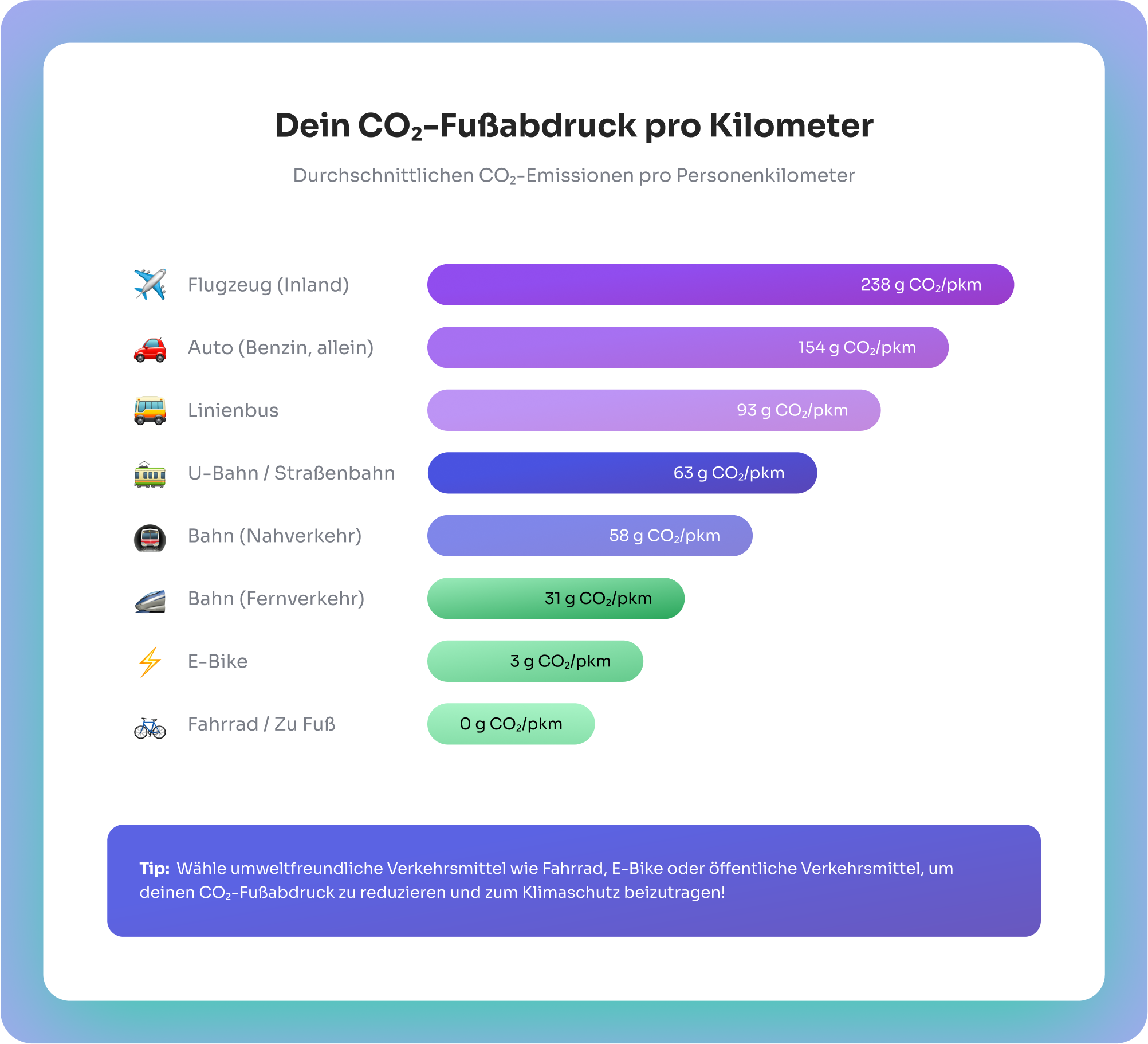
A specific example: For a typical commute of 10 kilometers (one way), you save around 2 kg of CO₂ per day by switching from car to the S-Bahn. Calculated per year (with 220 working days), that's over 440 kg CO₂ — for one person alone! Multiplied by the entire workforce, the potential quickly becomes apparent. A shift of just 10 percent of car traffic to public transport in Germany could save 5.8 million tons of CO₂ annually.
Here we answer the most frequently asked questions about the mobility budget briefly and concisely.
There is no legal upper or lower limit. In practice, monthly budgets of between €100 and €300 have been established. However, the ideal altitude depends on factors such as the company location, average commuting distances and strategic goals.
No, that's one of the big benefits. The budget can usually be used flexibly for business trips, commutes and purely private trips. However, tax treatment may differ depending on the purpose of use.
Yes, absolutely. Tax regulations such as the 50-euro payment in kind apply equally to all employees, regardless of weekly working hours. This makes the budget a particularly fair and inclusive benefit.
Yes, it's a perfect combination. Many companies offer both. The company bike covers the daily, active commute to work, while the mobility budget offers flexibility for other trips (e.g. in bad weather, for longer distances or transporting loads).
A classic travel allowance is often earmarked and limited to the distance between home and first place of activity. The mobility budget is a flexible credit that can be used for a much wider range of mobility services and also for private trips.
It depends on the provider. Outdated systems are based on the submission of supporting documents. Modern, digital solutions use a payment card, which automates the process and makes it unnecessary to submit receipts. This is the much more convenient and efficient method.
That depends on the provider. Some digital platforms with global payment cards make it possible to use the budget worldwide, which is a big advantage, especially for employees who travel a lot.
If your employer only uses the 50-euro benefit in kind and this value is exceeded, the entire amount for that month will be subject to tax and social security contributions. However, if your employer uses the new lump sum tax options (e.g. the 25% rule), you remain tax-free as an employee.
That is an important point. A completely tax-free public transport subsidy in accordance with Section 3 No. 15 EStG is offset against the removal allowance that you can claim in your tax return. A budget taxed in kind or as a lump sum is generally not counted. Tax advice is useful here on a case-by-case basis.
The tax rules in the background are complex, yes. But for you as a company, the introduction doesn't have to be complicated. With the right digital platform, the entire process, from set-up to administration to payroll, is automated and carried out in a legally compliant manner. The administrative effort for the HR department is then minimal.
The world of work has reinvented itself. Now is the time for corporate mobility to also make the leap into the future. The mobility budget is the flexible, cost-effective and sustainable answer to the requirements of new work, hybrid models and a new awareness of the environment and quality of life.
With its simplified and attractive tax laws, 2025 marks the perfect time to initiate change. You've seen how the budget increases employee satisfaction, positions your company as a top employer, saves costs and makes a measurable contribution to climate protection.
The future of work needs more than just new offices — it needs new paths. With a flexible mobility budget, you're not just giving your team a benefit. You give them freedom, appreciation and the chance to make a positive contribution every day — for themselves and for your region. Be the hero who reinvents mobility in your company.
author
Everything you want to know — simply explained.
Everything you want to know — simply explained.
What is the benefit card?
The HERO Card is a digital Mastercard debit card that allows companies to offer tax-free benefits easily and flexibly. Employees thus receive tax-free subsidies for benefits in kind, mobility, food and health. Everything bundled on one card, individually configurable and implemented in a legally secure manner.
Employees simply pay on a daily basis. Locally in your favorite café or nationwide in supermarkets, pharmacies or public transport.
How does that work for companies?
You control everything centrally in the HR portal.
Activate benefits in five minutes. The HERO Card automatically loads the monthly budget. Digital, secure and tax-compliant.
What are the concrete benefits of this for my team?
Up to 50 euros in kind per month
Meal allowance of up to 7.50 euros per working day
Mobility allowance of up to 58 euros per month
Up to 500 euros per year for health and wellbeing
All tax-free. It's all digital. It's all on one card.
How does HR keep track?
All benefits at a glance. No paperwork.
In the HR portal, you control budgets, see workload and manage everything centrally.
Sign in. Adjust. It's done.
This saves you up to 80 percent of administrative time.
Is that really tax-free?
Yes, all benefits are tax-free for employees and are completely legally compliant. Employers must tax some benefits as a lump sum.
The HERO Card uses legally enshrined allowances. Each category is correctly separated for tax purposes and can be managed automatically.
How much does the HERO Card cost?
As part of the employee license, the card costs 1 euro per employee per month plus charges for charging benefits.
For 50 employees with HERO Base, for example, this equates to around 140 euros per month — less than a joint team meal, but with a long-term effect.
How quickly is the HERO Card ready for use?
Ready to go in just a few days.
Setup, onboarding and go-live take a maximum of one week.
No technical hurdles. Without complexity.