Table of contents


Your ultimate guide to 40% savings and tax-free mobility. Learn everything about company bike leasing now!
Save with HERO RIDE

Flexible mobility budget instead of company cars. Up to 50€ per month tax-free for public transport, car sharing and more. Offer real freedom of choice, save costs and points as a modern employer.
Save costs nowImagine commuting to work every morning without traffic, saving hundreds of euros a year, and simultaneously doing something good for your health and the planet. Sounds like a dream? This is the reality with a company bike – the smartest employee benefit of our time. A company bike is far more than just a means of transport; it's a statement for a modern, sustainable, and healthy lifestyle. It's a clever tool that helps you optimize your finances, boost your fitness, and actively contribute to environmental protection.
In this ultimate guide, we'll take you on a journey through the world of company bike leasing. We'll show you why a company bike is a win-win situation for employees and companies, how the leasing model works in detail, and how you can leverage tax regulations to your advantage. Get ready to learn everything you need to get your dream bike today and become the hero of your commute.
A company bike is a bicycle or e-bike that an employer provides to their employees. It can be used for commuting to work as well as for unlimited private use, offering massive savings compared to a private purchase thanks to significant tax advantages.
Choosing a company bike is one of the smartest decisions you can make for your wallet, your health, and the environment. It's a benefit that goes far beyond its monetary value and sustainably improves your daily life. For both you as an employee and your company, the company bike unleashes unforeseen potential.
A company bike is your personal game-changer. It transforms the daily commute from a tedious chore into a positive experience and provides you with benefits you'll feel immediately.
Probably the most compelling advantage is the enormous financial saving. Compared to directly buying your dream bike, company bike leasing can save you up to 40% or even more. How is this possible? The trick lies in the so-called salary sacrifice. The monthly leasing rate for your bike is deducted directly from your gross salary, meaning before taxes and social security contributions are applied. This reduces your taxable income, and you pay less in contributions. Your net salary decreases by only a fraction of the actual leasing rate – all while you ride a brand-new, high-quality bicycle.
Do you dream of a high-end e-bike, a sporty mountain bike, or a practical cargo bike, but the high purchase price deters you? With the company bike model, this dream becomes a reality. Instead of a large one-time payment, the costs are spread over small monthly installments, typically over a period of 36 months.5 This makes even bikes worth several thousand euros affordable for everyone.
Every pedal stroke is an investment in your health. Regular cycling strengthens the cardiovascular system, improves endurance, reduces stress, and makes you mentally fitter. Employees who regularly cycle to work are demonstrably less often sick. You effortlessly integrate your daily workout into your routine, without having to schedule extra time at the gym.
A common misconception is that a company bike must primarily be used for commuting to work. That's incorrect. You can and should use your bike whenever and wherever you want: for a weekend tour with the family, shopping in the city, or a trip to the lake.1 Private use is explicitly permitted and encouraged, which significantly increases the value of this benefit.
Every kilometer you cycle instead of drive is an active contribution to climate protection. You reduce your carbon footprint, avoid noise, and help improve air quality in your city. With a company bike, you become part of the solution and demonstrate your commitment to a sustainable future.
The company bike model creates a strong emotional connection to the benefit, extending far beyond a mere monetary value. It provides access to a premium product that one might not otherwise be able to afford. Over the 36-month leasing period, this bicycle becomes an integral part of daily life and personal identity. If, at the end of the term, there's an option to acquire the bike for a low residual value, often just 18% of the new price, it doesn't feel like a purchase, but rather like retaining something that already feels like your own. This psychological component enhances the perceived value of the benefit and the positive association with the employer.
In a competitive job market, innovative employee benefits are crucial for attracting and retaining top talent. The company bike is more than just a nice perk – it's a strategic tool with a measurable positive impact on your business.
A company bike program is a clear sign of a modern and employee-centric corporate culture. It's a highly attractive benefit that sets you apart from the competition as an employer. Studies show that a large proportion of applicants consider such corporate benefits when choosing an employer. The company bike is a strong argument for convincing qualified professionals and retaining them long-term within your company.
Healthy employees are the foundation of a successful company. Promoting cycling has direct positive effects on sick leave and your team's productivity.
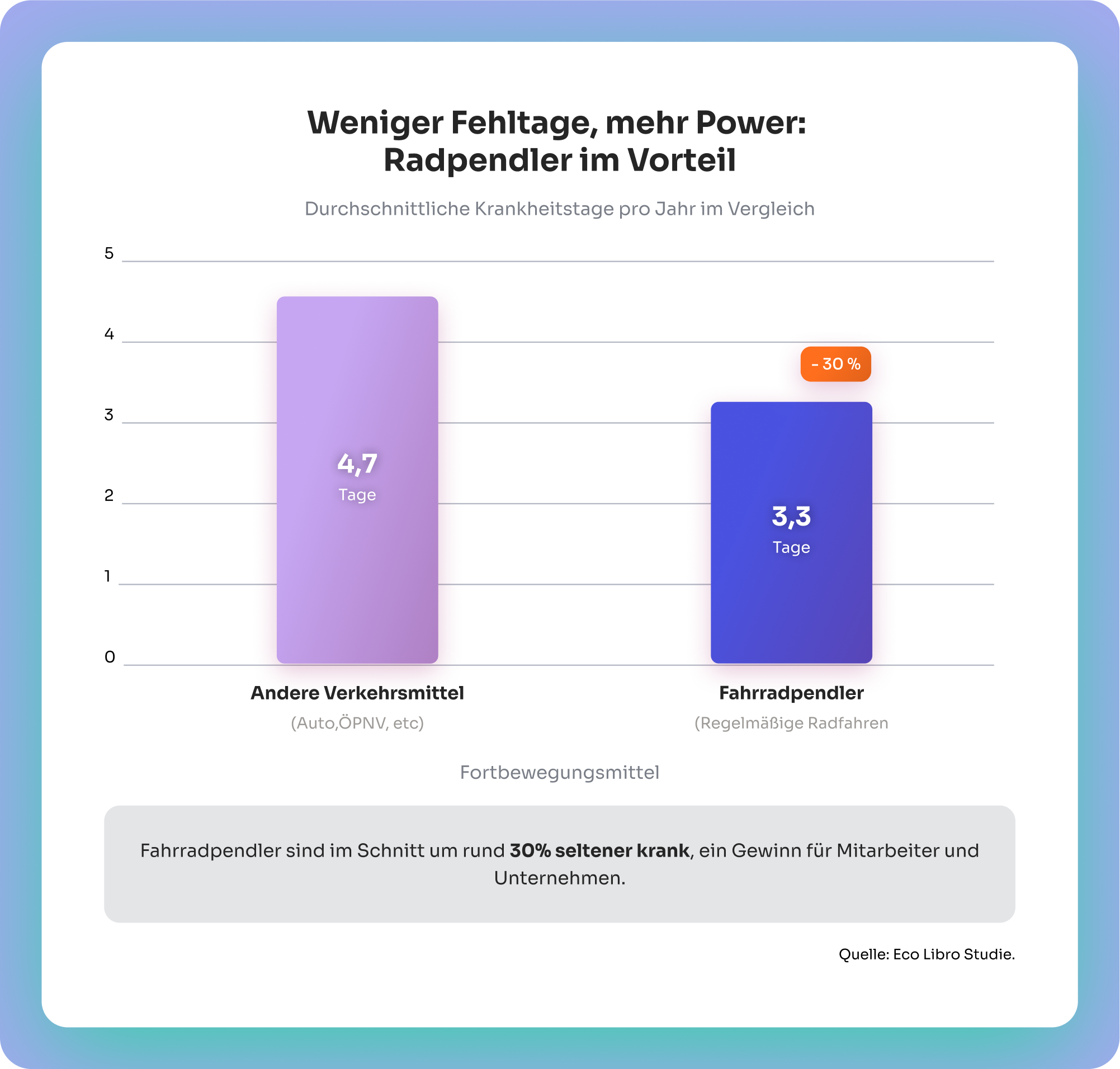
The link between cycling and health is scientifically proven. A study by Eco Libro impressively demonstrates how significantly the choice of transport affects absenteeism. While users of other modes of transport average 4.7 sick days per year, cycling commuters only have 3.3 days. That's a reduction of almost a third. Fewer sick days mean lower costs and higher productivity. According to the National Cycling Plan, billions in production losses can be avoided nationwide through more physically active employees.
For you as an employer, the common company bike model via salary sacrifice is generally completely cost-neutral. What's more: you can even save money. Since the leasing rate is deducted from the employee's gross salary, the basis for social security contributions is reduced. This lowers your ancillary wage costs – a direct financial relief for your company.
A company bike program is Corporate Social Responsibility (CSR) in action. You position your company as a modern, health-conscious, and sustainable employer. This not only strengthens your external image but also fosters employee pride and identification with their own company.
The concern about bureaucratic effort is unfounded. Leading leasing providers today offer fully digital platforms that automate the entire process, from bike selection and contract creation to managing leasing agreements. The administrative effort for your HR department is minimal, often limited to a few clicks for approval.
Introducing a company bike program is often more than just implementing a single benefit. It's frequently the first step that prompts a company to strategically address its employees' mobility. This process often reveals diverse needs within the workforce – some prefer public transport, while others occasionally need a car. The success and positive feedback from the company bike offering create an openness among leadership to consider more comprehensive and flexible solutions. Thus, the company bike becomes a "gateway benefit," paving the way for a transformation towards a holistic mobility concept, such as a flexible mobility budget.
Now that the many benefits are clear, the question arises: How exactly do you or your company get a company bike? The process is simpler than you think and is based on two central financing models, which we will now explain in detail.
The way a company bike is financed directly impacts costs and tax treatment. The two most common models are salary sacrifice and salary extra.
With salary sacrifice, the leasing rate is paid from your gross salary, which reduces your tax and social security burden. With salary extra, your employer covers the costs in addition to your wages, making the company bike completely free of charge and tax-exempt for you.
This is by far the most common form of company bike leasing. The principle is simple and ingenious: as an employee, you forgo a small portion of your contractually agreed gross salary. In return, you receive a non-cash benefit – specifically, the right to use your desired bike.3 The monthly leasing rate is deducted directly from your gross wages before taxes and social security contributions are calculated. This mechanism leads to the significant savings already mentioned. Additionally, you must pay tax on a small amount, the so-called "monetary benefit," but thanks to the favorable 0.25% rule, this barely makes a difference.
With the "Salary Extra" model, the employer is particularly generous. Here, the company covers the full leasing costs in addition to your normal salary. For you as an employee, the bike is a real bonus in this case – it is completely free of charge and tax-exempt. The legal basis for this is Section 3 No. 37 of the Income Tax Act (EStG). While this model involves direct costs for employers, it represents an extremely powerful tool for employee motivation and retention.
The choice between these two models says a lot about a company's strategic goals. Salary sacrifice is the pragmatic, cost-neutral way to offer a modern benefit and meet basic expectations. Salary extra, on the other hand, is a clear investment in employees. It's a conscious decision by companies that want to position themselves as premium employers in an intense talent competition and are willing to allocate financial resources for it. The chosen method thus reflects the company's HR philosophy.
The path to your new bike is a clearly defined and mostly digitized process. Regardless of the provider, the steps generally follow this simple scheme:
Abstract terms like "salary sacrifice" and "non-cash benefit" are best understood through a concrete example. The following table shows you how the costs for an e-bike with a new price of 3,000 Euros compare between a direct purchase and company bike leasing.
Note: The exact values in this example calculation may vary slightly depending on your individual tax bracket, federal state, church tax liability, and health insurance contributions. For a precise, personalized calculation, we recommend using an online benefit calculator, which most leasing providers offer.
The company bike model is so attractive because it is based on clear tax regulations. To fully exploit its potential and navigate the process safely, it's important to understand the legal and tax fundamentals. Don't worry, we'll break down the complex regulations into understandable bites for you.
Since you are allowed to use your company bike privately, the state considers this usage as a form of additional income, a so-called non-cash benefit. This benefit must be taxed and is referred to as a "non-cash benefit". However, for company bikes, the legislator has created an extremely advantageous regulation: the 0.25% rule.
The 0.25% rule is the method for taxing the private use of your company bike. With this rule, only a tiny fraction of the bike's value (specifically: 1% of one-quarter of the gross list price, rounded down to the nearest €100) is added to your salary monthly as a non-cash benefit and taxed.
The exact calculation method, as defined by the Federal Ministry of Finance (BMF), appears a bit complicated at first glance, but is essentially quite simple 30:
Calculation Example:
Let's take our e-bike again, with an MSRP of 3,000 Euros:
Your monthly non-cash benefit is therefore only 7 €. This amount is added to your gross salary, on which you then pay taxes and social security contributions. The actual net burden here is often only 2-3 Euros per month.
This regulation, which has been in effect since 2020, has revolutionized company bike leasing. It replaced the less favorable 0.5% rule (valid for 2019) and the original 1% rule (before 2019), making the model even more financially attractive. The current regulation is legally enshrined until the end of 2030, which provides you with long-term planning security.
There is a scenario in which you don't have to pay a single cent in taxes for your company bike: the Salary Extra Model. The legal basis for this can be found in Section 3 No. 37 of the Income Tax Act (EStG).
This law states that the provision of a bicycle by the employer is completely tax-free if it "in addition to the salary already owed" occurs. In plain terms: Your employer covers the full leasing costs without reducing your salary. There is no salary conversion. In this case, the taxation of the non-cash benefit is completely waived. The tax exemption applies not only to income tax but also to social security contributions, making it a 100% free benefit for you.
The provision agreement is the central legal document that regulates the relationship between you, your employer, and the company bike. It is an important supplement to your employment contract and provides clarity and legal certainty for both parties.
The provision agreement is an addendum to the employment contract. It regulates all rights and obligations between you and your employer regarding the company bike, such as usage period, costs, insurance, and the procedure in case of termination or prolonged illness.
A carefully drafted contract should cover the following points in detail:
While normal e-bikes (pedelecs) with pedal assistance up to 25 km/h are legally considered bicycles, fast e-bikes, known as S-pedelecs (assistance up to 45 km/h), fall into a different category. They are classified by law as motor vehicles , which entails significant differences in tax and practical handling.
First, the good news: The advantageous 0.25% rule for non-cash benefits also applies to S-pedelecs.23 However, there's a crucial addition: Similar to a company car, the commute between your home and your primary workplace must be taxed additionally. For this, a monthly 0.03% of the quartered and rounded list price per kilometer of distance is due.
As a motor vehicle, an S-pedelec is subject to stricter traffic regulations 38:
The company bicycle has revolutionized the world of employee benefits and paved the way for a new approach to corporate mobility. It's a fantastic benefit that offers the perfect solution for many. However, in a work environment that is becoming increasingly flexible and individualized, the question arises: Is there an even smarter solution that adapts not just to some, but to all employees? The answer is: Yes.
The company bike is an excellent first step. But what if you prefer to take the train in winter because the roads are icy? What if you need a car-sharing vehicle for a big grocery run? Or what if you live in a rural area where cycling to work is simply too far? A company bike is great, but it's just just a bicycle. It's a "one-size-fits-some" solution.
The true evolution of corporate benefits lies in flexibility and freedom of choice. This is where the flexible mobility budget comes into play. Imagine your employer doesn't provide you with a specific mode of transport, but rather a monthly credit that you can use completely freely for your individual mobility.
The Benefits of a Flexible Mobility Budget:
Modern providers take this a step further. With solutions like the HERO Ride Mobility Budget this flexibility is bundled into a simple app. You receive a budget on your HERO Card and freely decide how to use it – for leasing your dream bike, the Deutschlandticket, or your next train journey. This transforms a rigid benefit into a true, flexible superpower that adapts to your life while simultaneously strengthening local providers in your region.
Here we answer the most common questions about company bikes briefly and concisely.
Yes, this is possible in many companies. Your employer determines the exact number, but from a tax perspective, up to two bikes per employee simultaneously are generally fine. The second bike can often also be used by your partner or another family member living in the same household.
Generally, almost every bicycle model is eligible for leasing – from city bikes and e-mountain bikes to practical cargo bikes. However, your employer may specify a price range (e.g., from €595 to €10,000) or certain types of bicycles. Used bicycles are generally excluded from leasing.
After the leasing period expires, you usually have two options: You can simply return the bicycle to the leasing partner or accept a purchase offer. This is typically around 18% of the original new price. Many providers cover the flat-rate taxation of the benefit in kind resulting from the favorable purchase for you.
Yes, comprehensive insurance coverage is a key component of company bike leasing. Fully comprehensive insurance, which covers theft, accident damage, and often wear and tear, is typically included in the lease rate. Many packages also include regular maintenance and a mobility guarantee.
Yes, absolutely. Using a company bike does not affect your eligibility for the flat-rate commuter deduction (also known as the commuter allowance). You can still claim 30 cents per kilometer for each workday (38 cents from the 21st kilometer onwards) as income-related expenses in your tax return.
Yes, but the impact is very small. Salary sacrifice minimally reduces your gross salary, leading to slightly lower contributions to the statutory pension insurance. Over the entire 36-month term, this usually only amounts to a small fraction of a pension point, affecting your future monthly pension by just a few euros.
The salary sacrifice model is generally not applicable to marginally employed individuals (mini-jobbers), apprentices, employees during their probationary period, or employees with fixed-term contracts whose duration is shorter than the 36-month leasing period.
Modern leasing contracts offer comprehensive solutions for these cases. Usually, an employer default insurance included in the contract covers the installment payments in unforeseen events. Common options include taking over the lease privately, transferring it to a new employee, or returning the bike to the leasing partner free of charge.
No, that's not necessary and also not possible. The tax benefits of the company bike are realized directly through your monthly payroll by reducing your taxable gross salary. You do not need to make any additional declarations regarding the company bike in your income tax return.
The company bike is more than just a trend – it's an intelligent and sustainable answer to the mobility challenges of our time. It offers an unbeatable combination of financial benefits, health advantages, and a positive contribution to the environment. For employees, it means access to a high-quality dream bike with savings of up to 40%, while employers gain a cost-neutral and highly effective tool for employee retention and health promotion.
The clear tax framework, especially the advantageous 0.25% rule, creates a solid and reliable foundation for this win-win model. The process is straightforward thanks to digital platforms, and comprehensive insurance and service packages ensure a worry-free experience.
At the same time, the company bike marks the beginning of a larger development towards more flexible and individualized mobility solutions. It opens the door for concepts like mobility budgets, which give all employees the freedom to shape their commute and leisure travel themselves.
Whether you're an employee looking to take the first step or a company wanting to set up a forward-thinking benefits program: The company bike is the perfect starting point. It's your chance to save costs, get fitter, and start every day with a smile. Hop on – your future awaits.

author
Operations & Senior HR Consultant
Everything you want to know — simply explained.
Everything you want to know — simply explained.
What is the benefit card?
The HERO Card is a digital Mastercard debit card that allows companies to offer tax-free benefits easily and flexibly. Employees thus receive tax-free subsidies for benefits in kind, mobility, food and health. Everything bundled on one card, individually configurable and implemented in a legally secure manner.
Employees simply pay on a daily basis. Locally in your favorite café or nationwide in supermarkets, pharmacies or public transport.
How does that work for companies?
You control everything centrally in the HR portal.
Activate benefits in five minutes. The HERO Card automatically loads the monthly budget. Digital, secure and tax-compliant.
What are the concrete benefits of this for my team?
Up to 50 euros in kind per month
Meal allowance of up to 7.50 euros per working day
Mobility allowance of up to 58 euros per month
Up to 500 euros per year for health and wellbeing
All tax-free. It's all digital. It's all on one card.
How does HR keep track?
All benefits at a glance. No paperwork.
In the HR portal, you control budgets, see workload and manage everything centrally.
Sign in. Adjust. It's done.
This saves you up to 80 percent of administrative time.
Is that really tax-free?
Yes, all benefits are tax-free for employees and are completely legally compliant. Employers must tax some benefits as a lump sum.
The HERO Card uses legally enshrined allowances. Each category is correctly separated for tax purposes and can be managed automatically.
How much does the HERO Card cost?
As part of the employee license, the card costs 1 euro per employee per month plus charges for charging benefits.
For 50 employees with HERO Base, for example, this equates to around 140 euros per month — less than a joint team meal, but with a long-term effect.
How quickly is the HERO Card ready for use?
Ready to go in just a few days.
Setup, onboarding and go-live take a maximum of one week.
No technical hurdles. Without complexity.