Table of contents


Everything about the Deutschlandticket. Take advantage of tax benefits, inspire employees and save significantly in the process. Get informed now!
Save with HERO RIDE

Flexible mobility budget instead of company cars. Up to 50€ per month tax-free for public transport, car sharing and more. Offer real freedom of choice, save costs and points as a modern employer.
Save costs nowThe Deutschlandticket is a monthly ticket valid throughout Germany for all local and regional public transport. For a fixed monthly subscription price, it allows unlimited trips on buses, trams, subways, S-Bahn and regional trains throughout Germany.
What began as a bold experiment in summer 2022 has developed into a real revolution for mobility in Germany. You probably remember the 9 euro ticket: travel across the country easily and for an unbeatable price for three months. More than 52 million tickets sold impressively demonstrated what people were longing for: a simple, affordable and flexible alternative to the tariff jungle of countless transport associations. This social phenomenon was more than just a financial relief; it was proof that a radical simplification of public transport (public transport) is possible and desired.
A lasting solution was born from this success: the Deutschlandticket, often referred to as the D-ticket. It stands on three strong pillars that explain its immense popularity and fundamentally change the way you travel:
This guide is your comprehensive guide through the world of Germany tickets. We answer all your questions: from the current price to the exact validity rules to the often overlooked but crucial details when taking bikes or dogs with you. But above all, we dive deep into a topic that offers huge opportunities both for you as an employee and for companies: the Deutschlandticket as a job ticket. We'll show you how you can use it as an unbeatable employee benefit, what tax benefits await you and how modern companies can make this process smart and uncomplicated. Get ready to rediscover your mobility.
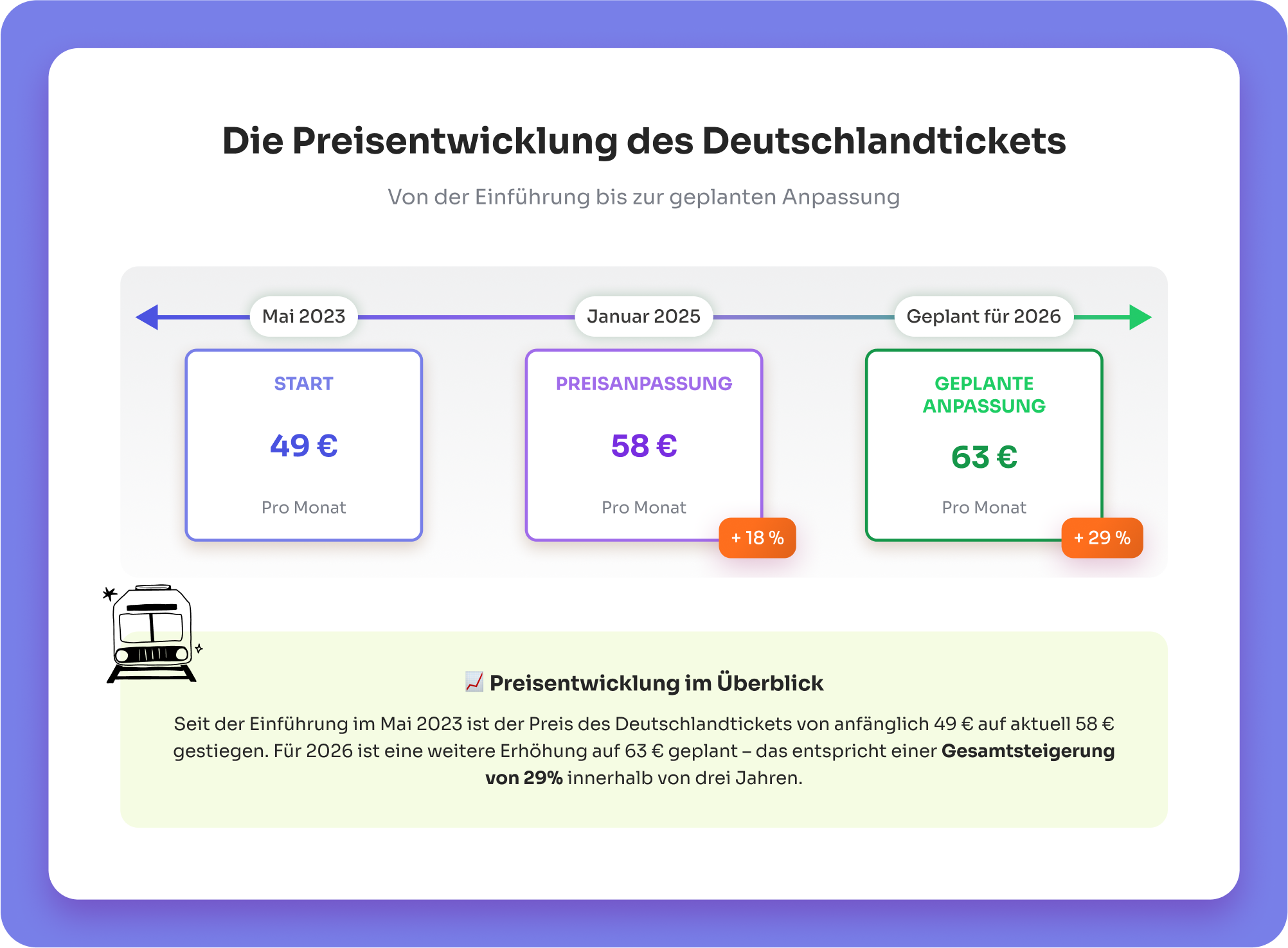
Since January 1, 2025, the Deutschlandticket has cost 58 euros per month. It is sold as a subscription that automatically renews but can be canceled monthly. A price increase to 63 euros is already planned for 2026.
The price of the Deutschlandticket is not a static amount, but the result of political negotiations and economic imperatives. To understand why you're paying 58 euros today and probably more in the future, it's worth taking a look at the development so far and planned:
There is a complex financing model behind these figures. The federal and state governments share the costs and compensate for the loss of revenue by public transport companies as a result of the cheaper ticket. Both sides each contribute 1.5 billion euros per year. The price adjustments are a direct response to reality: The operation of buses and trains is becoming more expensive. From 2027, the price should therefore be dynamically linked to a cost index that takes factors such as wage and energy cost developments into account. For you, this means that the Deutschlandticket will remain a price flexible product. You must be prepared for regular, moderate adjustments.
One of the most common questions is: Are there discounts for pupils, students, trainees, seniors or social benefit recipients? The answer is a clear yes. that standard-Deutschlandticket itself does not provide any such reductions nationwide. The price of 58 euros applies in principle to everyone.
However, the federal states have the option of offering additional benefits at their own expense. This results in a regional patchwork of special tariffs, which may be pleasing for beneficiaries, but can also be confusing. It is therefore always worthwhile to carefully check the offers in your federal state.
The table below gives you an overview of some of the most important regional discounts:
These regional offers show that countries want to specifically relieve certain groups of people. If you belong to one of these groups, you should definitely check with your local transport association or the responsible authorities in your federal state. The savings are often significant compared to the regular price.
The Deutschlandticket is valid nationwide on all public transport such as regional trains (RE, RB), S-Bahn, subway, tram and public buses. However, it is not valid on long-distance transport (ICE, IC, EC) or with private providers such as FlixTrain.
At the heart of the Deutschlandticket is its validity in all public transport (public transport) and local rail passenger transport (SPNV). But what does that mean in detail? The following table breaks down the most important means of transport for you:
In principle, the ticket is also not valid on means of transport that are primarily operated for tourist or historical purposes, such as mountain railways or museum railways.
The most important restriction that you need to know: The Deutschlandticket is not valid for long-distance Deutsche Bahn services (ICE, IC, EC) or with other long-distance transport providers such as FlixTrain. This clear separation between local and long-distance transport has far-reaching consequences, which you should consider in everyday travel.
You can use the Deutschlandticket perfectly to travel to and from a long-distance train station. So you take the S-Bahn to the main train station to get on your ICE there. Legally speaking, however, you are concluding two separate transport contracts. This becomes a problem when something goes wrong: If your regional train is delayed and you therefore miss your ICE, for which you have a train connection ticket (e.g. a super savings price), this train connection is not canceled. You are not entitled to a free rebooking or refund, as the delay took place under another contract (that of the Deutschlandticket). That is a financial risk that you need to know.
There are a few exceptions to the rule. The Deutschlandticket may be valid on certain sections of the route on which long-distance trains virtually take on a local transport function because there are no parallel regional trains. These exceptions are the result of special agreements between the federal states and DB Fernverkehr. An official and up-to-date list of these routes can be found on the Deutsche Bahn website. Always check this before you start your journey!
Under very specific circumstances, passenger rights allow the use of a higher-quality train. If you are traveling with a Deutschlandticket and it becomes apparent that you will reach your destination with a delay of at least 20 minutes, you can switch to an ICE or IC. The catch: You must first buy the ticket for the long-distance train yourself and can later have the costs reimbursed by the responsible railway company. This regulation is intended as an emergency solution for exceptional cases.
As the name suggests, the Deutschlandticket is primarily intended for trips within Germany. However, there are a number of cross-border routes where the ticket is also accepted, usually to the first train station in the neighboring country. This makes life much easier for commuters and travelers in border regions. The destinations that you can reach with the Deutschlandticket include:
These regulations are based on specific agreements and may change. You can find a detailed overview in the official tariff regulations, which are often offered as a PDF download by Deutsche Bahn.
The validity rules show an important feature of the Deutschlandticket: Although it overcomes the countless tariff limits within Germany, it does not overcome the fundamental system limits between local and long-distance transport. The simplification of buying tickets doesn't mean that you no longer have to deal with the different rules and rights of the various transport systems. An awareness of these limits protects you from unexpected costs and problems on your journey.
The Deutschlandticket is a personal, non-transferable ticket. The transport of people over 6 years of age, bicycles or dogs is not included in the package. The exact rules for taking bicycles and dogs vary depending on the transport association and federal state.
The Deutschlandticket is consistently tailored to one person. That means it is personalized and can't be used by friends, family, or colleagues. Your name is marked on the ticket, and during a ticket inspection, you must be able to identify yourself with a valid official photo ID (e.g. identity card, passport or driver's license). This regulation is a significant difference from many previous, transferable monthly passes.
The rules for bringing other people along are extremely simple and leave no room for interpretation:
While the transportation of people is uniformly regulated nationwide, there is a complex confusion when it comes to transporting bicycles. This is one of the most frequently criticized points and a major challenge for travelers. The principle is: Nationwide bicycle transportation is included in the price of the Deutschlandticket not included.
The individual federal states and transport associations are responsible for the regulations on transporting bicycles. This federal structure means that the original idea of simplification is reaching its limits. Instead of a clear rule, there is a mosaic of countless local regulations. Before you take your bike with you on the trip, you must inform yourself about the local rules.
The following table gives you an exemplary overview of the variety of regulations:
This complexity shows that the Deutschlandticket alone is often not enough for seamless mobility by bicycle. The need to learn about local rules before every trip is contrary to the basic idea of simplicity.
Similar to bicycle transportation, there is also no uniform nationwide regulation for bringing dogs along. The regulations are set by local transport associations. The good news, however, is that the regulations here are often more generous than when it comes to transporting a bicycle.
In many major transport associations such as the VBB (Berlin/Brandenburg), the MVV (Munich) or as part of Deutschlandticket job at BVG Is it allowed to bring a dog free of charge.
However, in other regions, a discounted ticket or a special dog ticket may be required. There is no guarantee of free, nationwide transportation.
Here too, the following applies: A quick look at the website of the local transport association saves you from possible hassle during an inspection.
Your employer can offer you the Deutschlandticket as a job ticket. If your company subsidizes at least 25% of the price (currently €14.50), there is an additional 5% discount (currently €2.90), meaning that you only pay a maximum of €40.60 per month.
The Deutschlandticket as a job ticket is one of the most intelligent and effective forms of employee benefits on the market. It creates a classic win-win-win situation: for you, for your employer and for the environment.
Your benefits as an employee:
The benefits for your employer:
The funding model is clearly defined: In order to receive the additional 5% discount, the employer must pay a minimum subsidy of 25% of the regular ticket price. The invoice currently looks as follows (at a price of 58€):
Of course, your employer also has the option of paying a higher subsidy. Many companies even cover 100% of the costs. In this case, you travel completely free of charge. Compared to a gross salary increase, which would have the same net effect, the complete transfer of the job ticket is often the significantly cheaper option for the employer, as there are no additional wage costs.
The Deutschlandticket job is therefore more than just a travel allowance. It is a strategic instrument of personnel policy. Companies that offer it send a clear signal: They invest in the quality of life of their employees and assume social responsibility. If your employer hasn't made this offer yet, it's worth seeking an interview — the benefits are obvious.
The introduction of the Germany ticket as a job ticket is a big step, but for many HR departments, this is just the start of the actual work. The traditional management of job tickets can be surprisingly complex: Contracts must be concluded with local transport companies, monthly order and cancellation lists must be maintained, and statements must be correctly recorded in payroll accounting. Especially for small and medium-sized enterprises (SMEs) without large HR resources, this administrative effort can be a significant hurdle. In addition, a rigid “one-size-fits-all” ticket does not always meet the needs of all employees. What about the colleague who prefers cycling or the team member working from home who barely uses public transport?
This is where a modern and much more flexible approach comes in: the Mobility budget. Instead of giving all employees a lump sum for Germany, the employer provides a monthly budget. Employees then decide for themselves how they want to use this budget for their individual mobility. This could be the Germany ticket, but also car sharing, e-scooters, bike sharing, the BahnCard or even charging a private e-car. This approach offers maximum freedom of choice and does justice to the diverse living and working models of today.
Digital benefit platforms are used precisely at this interface between flexibility for employees and simple administration for companies. They are the technological answer to the challenges of the modern benefit world. Instead of managing separate contracts for each individual benefit, these platforms bundle various tax-optimized subsidies — such as mobility, food allowance, health promotion, or benefits in kind — on a single, digital and easy-to-use interface.
Imagine that as a company, you could simply have the Deutschlandticket and all other mobility offers billed using a single card that every employee receives. That is the vision behind innovative solutions such as the upcoming HERO Ride by Regional Hero. Such systems massively relieve the HR department of administrative burden. The process is digitized and automated: from budget allocation to document verification to correct posting for payroll.
A benefit card like the HERO Card This makes it a universal tool for all your grants. Your employees can use it to pay for their own Deutschlandticket subscription, but also shop at local stores and thus strengthen the regional economy — all tax-optimised and with minimal effort for your company. This combines the advantage of a national offering such as the Deutschlandticket with targeted promotion of local purchasing power, which creates double added value.
To make the benefits tangible, let's look at a hypothetical example:
The problem: “Innovativ GmbH”, a medium-sized tech company with 150 employees, wanted to offer the Deutschlandticket as a job ticket in order to score points in the competition for skilled workers. However, management shied away from the administrative effort of concluding a framework agreement with the local transport company and manually managing monthly changes (new hires, cancellations). There were also concerns about fairness towards employees who would not use the ticket.
The solution: Innovativ GmbH decided against a rigid ticket contract and to introduce a flexible mobility budget via a digital benefit platform, analogous to the RegionalHero model. Each employee received a monthly mobility budget of 60 euros posted to their personal benefit card.
The result:
This example shows that the strategic advantage for companies today is no longer just whether they offer a benefit such as the job ticket, but above all in like they do it. Digital, flexible and employee-centred solutions are the key. They save valuable HR resources, increase the attractiveness of the benefit package and position the company as a modern and future-oriented employer.
Yes, the Deutschlandticket subsidized or provided by the employer is exempt from tax and social security contributions in accordance with Section 3 No. 15 EStG if it is granted in addition to the salary owed anyway. This is a separate regulation, which applies independently of the 50-euro exemption in kind.
The tax treatment of the job ticket is a decisive factor that makes it so attractive for both employers and employees. The regulations may seem complex at first glance, but once you understand them, they open up significant savings potential.
The central legal basis for the tax-free job ticket is paragraph 3 number 15 of the Income Tax Act (EStG). This provision states that subsidies and benefits in kind from the employer for the use of public transport are exempt from tax and social security contributions. As a pure public transport ticket, the Deutschlandticket is fully covered by this regulation.
The most important requirement for this tax exemption is the so-called Additionality requirement. This means that the subsidy or ticket must in addition to the salary owed anyway be granted. A salary conversion in which you, as an employee, waive part of your gross salary and receive the ticket in return, does not meet this requirement. In such a case, the ticket would be a taxable payment in kind.
A common misconception is the mixing of the tax-free job ticket with the 50-euro benefit allowance in kind. The distinction is very clear here:
This has a fantastic consequence for you and your employer: Both benefits can combines become! A company can provide you with the Deutschlandticket as a job ticket completely tax-free and ancillary still grant a tax-free payment in kind of up to 50 euros per month, for example via a benefit card such as HERO Base by Regional Hero. The two regulations do not consume each other.
However, the tax exemption under Section 3 No. 15 EStG has a downside that you need to know. In order to avoid double tax relief, the tax-free amount that you receive from your employer for your ticket is added to your Distance allowance (also known as commuter allowance) is credited.
In concrete terms, this means: In your annual tax return, you can claim the costs of your commute as advertising costs. The amount that your employer has contributed tax-free for your job ticket reduces this deductible amount. Your employer is obliged to show this tax-free subsidy in line 17 of the income tax certificate so that the tax office can offset it.
However, there is an elegant way to avoid this disadvantage for the worker. Instead of using the tax exemption under Section 3 No. 15 EStG, the employer can voluntarily tax the job ticket subsidy at a flat rate of 25%. The legal basis for this is Section 40 (2) EStG.
At first glance, this sounds like a disadvantage for the employer, as he has to pay taxes. But for you as an employee, this model has a huge advantage: The Elimination of the distance allowance is completely omitted! You can therefore claim the full amount for your commute in your tax return and benefit from a cheap or free job ticket at the same time. Depending on your individual tax situation and the length of your journey to work, this may be a significantly more financially advantageous option for you.
An employer who not only offers the job ticket, but also chooses the most favorable tax arrangement for its employees, shows the highest level of appreciation. Communicating this additional advantage can be a powerful argument in employer branding. It is therefore crucial for HR departments to know these options and, together with a tax advisor or a competent benefit provider, to find the optimal solution for the company and its employees.
The Deutschlandticket is worthwhile for most commuters and regular public transport users. In many major cities such as Hamburg, Berlin or Cologne, it is significantly cheaper than previous monthly passes, which can often save you 30 euros and more per month.
The best way to answer the question of whether the ticket pays off for you personally is by making a direct comparison with the prices that were usual for monthly passes before its introduction. The price of 58 euros may not sound like a bargain in itself, but in the context of the previous tariff structure, the enormous savings potential becomes clear.
Let's look at the situation in some of the biggest German cities. The prices for local monthly subscriptions were often heavily dependent on the number of tariff zones traveled through and could quickly reach high three-digit amounts. The Deutschlandticket has replaced this complex and often expensive structure with a single, transparent price.
The table below shows how much you save compared to the old plans:
Note: The prices of the old monthly passes are based on the status before and at the time of the introduction of the Deutschlandticket and may vary slightly depending on the subscription model.
The figures speak for themselves: Even in Munich, where the price difference for the urban area is the smallest, the Deutschlandticket offers the invaluable advantage of being valid nationwide. In cities such as Cologne, Berlin or Hamburg, the financial savings for commuters are dramatic. For regional commuters who used to have to cross several tariff zones and often paid over 200 euros per month, the savings potential is even greater.
The introduction of the Deutschlandticket has postponed the entire calculation of mobility costs. The decision for or against a subscription is no longer just a purely rational assessment of daily commuting costs. It is a decision for a new form of freedom and flexibility. The psychological effect of a “mobility flat rate” lowers the hurdle of leaving the car behind and using public transport — whether for a trip to work or a trip over the weekend.
You can cancel your Deutschlandticket subscription at any time, but you must respect the cancellation period. The cancellation must always be made by the 10th of a month so that it takes effect at the end of the same month.
One of the biggest advantages of the Deutschlandticket compared to traditional annual subscriptions is its enormous flexibility. You are not bound for twelve months, but can decide on a monthly basis whether you still need the ticket. The cancellation process is usually straightforward and digital, but you need to keep an eye on a crucial deadline.
The notice period is uniformly regulated by almost all Deutschlandticket providers: The cancellation must up to the 10th calendar day of a month have been received in order to take effect at the end of this month.
In practice, this means:
This deadline is crucial to avoid unwanted extensions and costs. A calendar entry as a reminder can be worth its weight in gold here.
The cancellation of your subscription usually takes place where you completed it. Since the Deutschlandticket is a digital product, the cancellation channels are usually also digital and self-explanatory.
The most common way: The online customer portal
Most transport companies (such as Deutsche Bahn, MVG in Munich or BVG in Berlin) provide an online customer portal. There, you can manage your subscription yourself. The typical process looks like this:
Alternative: Cancellation directly in the app
Some providers, such as Deutsche Bahn with its DB Navigator, also allow you to cancel directly in the app. Under the details of your mobile phone ticket, you will often find an option such as “cancel subscription.”
Emergency solution: The cancellation formIf the digital route doesn't work, many companies also offer a standardized online cancellation form that you can fill out and send.
Yes, absolutely. That is exactly what makes the subscription flexible. For example, if you only need the ticket for a vacation trip in August, you can buy it at the beginning of August and then just have to cancel it by August 10. This means that you only pay for one month and the subscription is not automatically extended into September.
The Deutschlandticket is more than just a travel ticket. It is a promise: the promise of simple, affordable and flexible mobility throughout Germany. It has thinned out the confusing jungle of tariffs and opened a door to a new way of traveling. But as with every revolution, there is light and shadow here too.
The unbeatable benefits at a glance:
The points you should consider:
The Deutschlandticket is here to stay. It will continue to evolve, prices will adapt to economic realities, but the basic principle will last. It is a fundamental building block for the transport revolution and a strong argument for public transport.
A particular appeal is addressed to employers: In a working world characterized by flexibility, sustainability and competition for the best talent, intelligent employee benefits are no longer a “nice-to-have” but a strategic must. The Deutschlandticket as a job ticket is one of the most effective and simple ways to show employees genuine appreciation and position yourself as a modern employer.
The real mastery lies in implementation. Instead of burdening yourself with administrative burdens, enable modern, digital benefit platforms such as RegionalHero a smart and flexible administration. They convert a simple travel allowance into a versatile mobility budget that meets the individual needs of each employee. This is how this top benefit develops its full potential — as a gain for your team, as a strengthening for your company and as a contribution to a sustainable future in your region.
author
Everything you want to know — simply explained.
Everything you want to know — simply explained.
What is the benefit card?
The HERO Card is a digital Mastercard debit card that allows companies to offer tax-free benefits easily and flexibly. Employees thus receive tax-free subsidies for benefits in kind, mobility, food and health. Everything bundled on one card, individually configurable and implemented in a legally secure manner.
Employees simply pay on a daily basis. Locally in your favorite café or nationwide in supermarkets, pharmacies or public transport.
How does that work for companies?
You control everything centrally in the HR portal.
Activate benefits in five minutes. The HERO Card automatically loads the monthly budget. Digital, secure and tax-compliant.
What are the concrete benefits of this for my team?
Up to 50 euros in kind per month
Meal allowance of up to 7.50 euros per working day
Mobility allowance of up to 58 euros per month
Up to 500 euros per year for health and wellbeing
All tax-free. It's all digital. It's all on one card.
How does HR keep track?
All benefits at a glance. No paperwork.
In the HR portal, you control budgets, see workload and manage everything centrally.
Sign in. Adjust. It's done.
This saves you up to 80 percent of administrative time.
Is that really tax-free?
Yes, all benefits are tax-free for employees and are completely legally compliant. Employers must tax some benefits as a lump sum.
The HERO Card uses legally enshrined allowances. Each category is correctly separated for tax purposes and can be managed automatically.
How much does the HERO Card cost?
As part of the employee license, the card costs 1 euro per employee per month plus charges for charging benefits.
For 50 employees with HERO Base, for example, this equates to around 140 euros per month — less than a joint team meal, but with a long-term effect.
How quickly is the HERO Card ready for use?
Ready to go in just a few days.
Setup, onboarding and go-live take a maximum of one week.
No technical hurdles. Without complexity.